Good morning gamers,
In our last post, we looked at how you can get the most effective use out of
Sorcerous Blast. Today, we turn to the most ubiquitous spells in the Middle-Earth Strategy Battle Game: Immobilize (or Transfix). While your damage potential can be quite large with Sorcerous Blast (even given the newest changes that limit how far a model can be thrown), Immobilize focuses instead on one particular model and takes away a lot of that model's capabilities. While not as good at one-turn-killing a hero as it used to be, it is able to take a hero out of the action for an important round (or out of the game if cast on successive turns).
Immobilize/Transfix: What Does It Do?
If you've used a spell-caster in MESBG, chances are you've used Immobilize or Transfix before. Whether you're using a wizard (Gandalf, Saruman, Radagast), a Ringwraith (named or unnamed), an Elven mage (Galadriel, Celeborn, Gildor - but not Elrond, Arwen, Cirdan, the-other-Galadriel, storm callers, or Thranduil), or some big magic-powered monster model (Smaug, Dragon with Wyrmtongue, Sauron, and the Necromancer - who isn't technically a monster), you've probably had Immobilize or Transfix in your arsenal (which one is often determined by whether they are a Forces of Good model or a Forces of Evil model).
 |
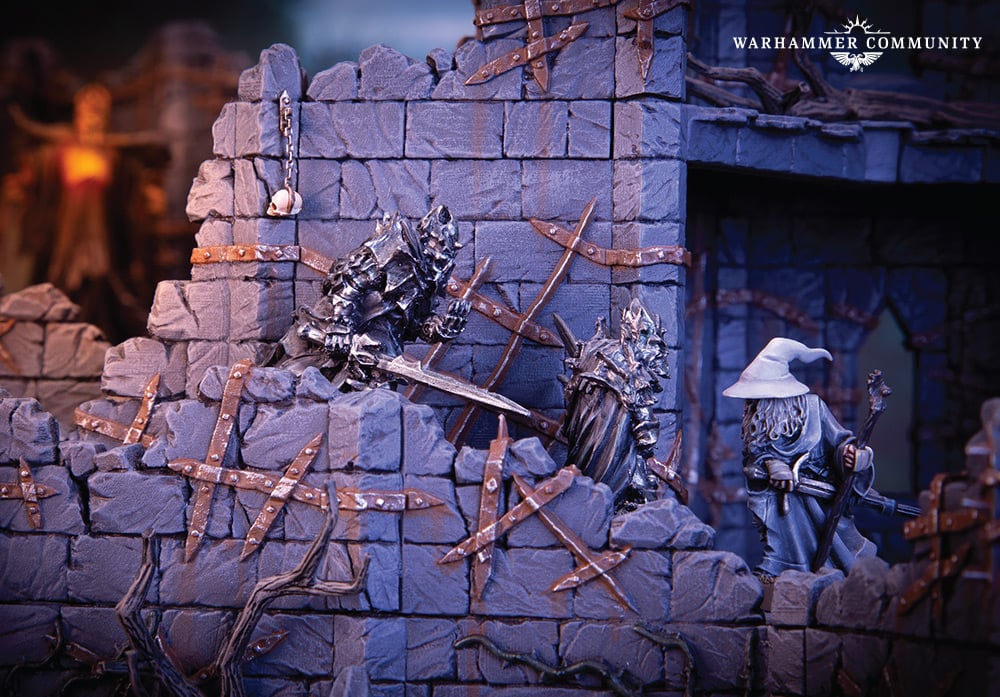
| Pro tip: if you wait to start casting Immobilize until your opponent is this close, you're in for some trouble . . . |
When I first got started in MESBG, Immobilize/Transfix was frowned upon in our group because if it was successfully cast, your Fight Value was reduced to 1, your Attacks were reduced to 1, and you couldn't make Strikes (in addition to other things, which we'll cover in a minute). That was . . . too powerful (especially when cast on a 3+ or a 2+ by most models that had it). In the current edition, Transfix doesn't affect your stats unless you channel it.
To understand what Immobilize does now, let's take a quick look at the rules (factoring in the Designer's Commentaries for the main rulebook):
- You pick an enemy model to target;
- You roll to cast the spell and the target can attempt to resist the spell;
- If cast successfully...
- The target is unable to call Heroic Actions or use active abilities.
- In the Move phase, the target cannot move, call a Stand Fast, or cast spells.
- In the Shoot phase, the target may not shoot.
- In the Fight phase, the target may not makes Strikes if they win a Duel.
- If the spell was channelled, the Fight Value and Attacks of the target model are halved, rounding up.
So what does this mean practically? It means that Transfix can be used to do the following kinds of things:
- Prevent casters who haven't acted yet from casting spells;
- Prevent fast models from charging you;
- Prevent supporting models who haven't moved yet (such as banner-bearers, shades, Cirdan, Gamling) from moving with their battle line and providing their auric boosts;
- Prevent archer models from being able to shoot for the turn;
- Prevents a powerful model from getting the benefits of their Heroic Actions (like Heroic Strike) or Active Abilities (such as Lord of the West).
- Prevent combat models from killing things.
This post will be focusing primarily on Immobilize/Transfix, but keep in mind that everything we cover here also applies to Command/Compel (with the exception that this spell is usually +1 pip harder to cast and adds a half-move to the target before it's not allowed to move again). There are tactics that you can use with Command/Compel that you don't get with Immobilize/Transfix, so we'll cover those that at the very end (but by and large, they will do the same thing and can be used in similar strategies).