Featured Post

So It Begins, Part 8: Ride Out

  Good morning gamers, For the astute observer, we jumped from Scenario 6 to Scenario 8 - this isn't a typo. Centaur's 3D printer wa...

Showing posts with label Barad-Dur. Show all posts

Thursday, July 2, 2026

Stupidly Fun Lists, Part I

Good morning gamers,

Recently, we had a "longtime reader" send us the following comment:

I have 2 rather stupid but fun list ideas. This is already a suggestion for a category for you guys ;) "Just dumb fun lists" or so.
Anyway: List 1: All artillery gondor (3 Trebuchet,, 3 avenger bolt throwers, flesh out with whatever.
List 2: All fellbeast mounted nazgul, air superiority fighters. Welcome to the black dart missile age.
I always wanted to run this with allied dol guldur nazguls or castellans if somehow possible, but well.
Alternatively: Troll-only Barad dur squad. I still have to paint my trolls though

I began writing a reply when I decided that the "comments section" of an old post wasn't the right place to do it. This got me thinking as well about what lists would be "stupidly fun" to run - and maybe these thoughts will give you things to think about as well. With that, let's kick off a new series on "stupidly fun" lists to run - and how to make them viable (if not competitive). For the sake of starting somewhere, our lists today will all be 650pts - this should mean that you're probably 100-150pts off of whatever game you're playing, since many events are still run at the 500-800pt level.

Monday, November 10, 2025

The New Age Is Begun: the Barad-Dur army list

Good morning gamers,

We recently had our annual THRO tournament here at TMAT and we had three guys who participated in five game days for Star Wars Legion (a four-part tournament and a single-day three-game Recon event) and one intro-to-Bolt-Action game day who joined us for their first Middle-Earth event. One of them expressed an interest in running Sauron . . . and I was like, "Well, we know the three scenarios you're going to play and he's not a bad take." So that got me thinking faster than normal about how the Barad-Dur list has changed in this edition - and as a result of much thinking, here's an article. :) Also, there's only one Legacy profiles to examine, so any discussion of that profile is marked in red, per the usual for this series.

Barad-Dur: Changes for 2025

Profile Selection

The profile selection is more or less what it was before - we still get access to Sauron, the Witch-King, and generic Ringwraiths for our spirit contingent, we still get access to Troll Chieftains and Mordor Trolls (both of which saw glow-ups to help them out this edition) for our supporting monsters, we still have access to siege weapons (both kinds) to provide long-range support, and we still have access to basic Orcs and Black Numenorean heroes/warriors, like we did in the last edition.

What we've lost in this edition is Shelob and Orc Taskmasters - and honestly, if that's all you're losing, you're in a pretty good place. Shelob is a very maneuverable piece and she added a bunch of the special rules she used to get only in the Cirith Ungol list into her base profile, so it's a bit sad that she's not available here. Not being able to whip Sauron into getting a free Might point when he declares Heroic Moves may not have been much of a thing in the last edition, but it could have been a thing . . . and now it's not.

All told, the world is still a pretty good place for this list and if you were used to running it previously, not much has changed (though some of the profiles and options have changed, so pay close attention when list building and invoke that arcane art of "reading").

Monday, July 29, 2024

Nemesis: How to Fight Against Mordor Troll Chieftains

Good morning gamers,

Earlier this year, we were asked if we could write Nemesis articles for the Witch-King of Angmar and Mordor Troll Chieftains. A few weeks ago, we covered the Witch-King (as an extended discussion of Ringwraiths, who have already shown up generally in this series). Today, we're tackling Mordor Troll Chieftains who . . . get a bit of a bad wrap in competitive circles.

Back when I started playing MESBG (back when it was LOTR SBG and Heroic Strike wasn't a thing), Mordor Troll Chieftains were scary - they were generic heroes who had base F7, giving them an edge over basically any hero in the game. After the rise of Heroic Strike (and its proliferation on a ton of units), having a base F7 stat doesn't usually matter until those "Strike heroes" are out of Might. F7 just isn't what it used to be . . .

. . . but Troll Chieftains are still F7/S7 monsters and if you find yourself across the table from one, you could be in for it. As a result, we're going to discuss today how to beat these guys - and while we're at it, we're going to look at an interesting corollary set of units you can beat with similar strategies: most Dwarf Infantry heroes.

What Makes Mordor Troll Chieftains So Hated?

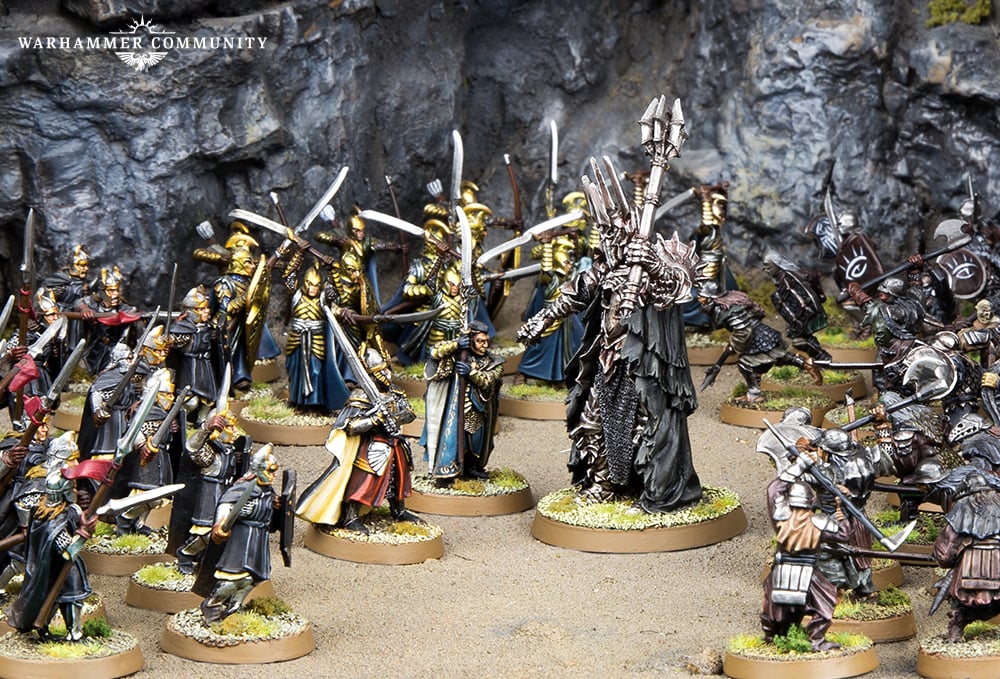
Photo Credit: Warhammer Community (and a really great article, despite its age)

While Mordor Troll Chieftains receive some censure from competitive players, a LOT of Dwarf heroes are touted as being excellent profile-for-cost units and while you may not see these guys crushing all of the top tables, a solid Dwarf list is a good gatekeeper list that will separate the "bad" lists from the "good" lists. A lot of that is tied to how points efficient their heroes (and most of their warriors) are - and if we understand what makes Dwarf heroes so good (and what they lack), we'll learn a lot about what makes Mordor Troll Chieftains good as well.

Regardless of the Dwarf list you're fielding (except Thorin's Company), it's not hard to find at least one named hero profile and at least one generic hero profile that's F5-6, effectively S6 with/without a dueling penalty (and if that's from the Khazad-Dum/Moria army list, you probably have access to Piercing Strike as well), D8-9, 2-3 Attacks, 2-3 Wounds, and either 2-Might-and-Strike or 3-Might-and-Strike (generic heroes from the Hobbit have 2-Might-and-March, but the Master of Battle (5+) on Iron Hills Captains means they CAN call Heroic Strike for free if an enemy hero nearby calls a Heroic Strike). If you went looking for this in other factions (we'll look at "the big four" of Minas Tirith, Rohan, Mordor, and Isengard), you'd be hard-pressed to find any models that meet this description at the 65-120 price point of most Dwarf heroes - even if you drop the D8 requirement that basically no one outside of Dwarves/monsters can reach (Knights of the White Tower check most of those boxes at 60pts each and add Mighty Blow to the mix - but they are quite a bit squishier than Dwarf heroes).

Monday, April 22, 2024

Nemesis: How to Fight Against the Dark Lord Sauron

Good morning gamers,

We're back with a how-to-counter-tough-models post today and since we covered the "big four" heroes of the Last Alliance, it seemed fitting that we'd also cover Sauron in the discussion - especially since he showed up on most of their countering lists. If you make a short list of models that are a) great in combat, b) hard to kill, and c) great at casting magic, Sauron is probably very, VERY high on the list. He's expensive, but he also does it all. So if you see him on the other side of the table, what on Middle-Earth are you supposed to do? Well, let's dig into what makes this guy good - and then we'll look at how to beat him.

What Makes The Dark Lord Sauron So Hated?

Any discussion about Sauron has to begin with his profile - he's got a beastly combat profile with F9, S8, 4 Attacks, and 3 Might with the option to call Heroic Strike (though when you start from F9, there's a real risk against F5-6 heroes that you don't need it). If his offense was great and his defense was poor (like Gulavhar), he probably wouldn't be worth his cost, but with Defense 10 (the only hero in the game with a Defense rating that high), 5 Wounds, and a 2+ mightable save against the final wound he suffers thanks to his modified One Ring rules, wounding Sauron is hard - and killing Sauron is all but impossible. 

Photo Credit: Warhammer Community

If you'd like to see a rather hilarious science experiment about how hard it is to kill Sauron, you should check out the Conquest Creations video that Jacob Lucas did earlier in the year - if you don't mind spoilers,
 Sauron managed to kill 532 Hobbit Militia over 157 turns and died after making 17 One Ring saves . . . no game is going to last that long, of course - and it's very rare that you'll see over 500 Hobbits on the board . . . or that all you'll be facing are Hobbit Militia with axes. :)

He's also got a great spell array - arguably the greatest in the game (I certainly think so). Most of his spells have an 18" range (6" longer than most other casters), and he can cast Drain Courage/Transfix on a 2+, Compel on a 3+, and Chill Soul/Sap Will on a 4+, giving him the ability to neutralize low-Will heroes while they're a long way off to slow their advance, weaken Ringwraiths with either of his 4+ spells from beyond a Fly-able charge range, and he can pluck wounds off army leaders or banner-bearers far before they get into combat with him. Oh, and he casts Instill Fear on a 3+, which can be great for clearing out objectives (especially when paired with his Ancient Evil special rule).

Monday, January 1, 2024

In Defense Of: Mordor Trolls (and sort of Isengard Trolls)

Good morning gamers,

First off, happy new year! Or, for you math-heads out there . . .

Golly, I love math . . . I know, I have a problem . . .

We're back in our In Defense Of series for the next few weeks and I wanted to start off with what has become one of my favorite Mordor units: the Mordor Troll. If you ask basically any competitive player, they will tell you that these models are just not worth taking - which is a real shame, because they have been available in both of the starter sets since the MESBG revamp and are highly customizable models (not to mention that Mordor/Isengard Trolls can be fielded in three army lists, as well as three Legendary Legions - yes, there are three of them, check my work if you like).

Photo Credit: Warhammer Community
Also, don't miss the weapon swaps on all the Orcs . . .

There are a wealth of reasons why these models are discouraged from competitive play and today, we begin the year with the impossible task of trying to provide a counter-perspective to . . . basically everyone in the community, including me from a year ago (though I don't know that this will be as hard of a sell as defending Osgiliath Veterans) . . . so in typical Tiberius style, let's get into it!

Why NOT To Take Mordor Trolls

Any discussion of Mordor Trolls has to begin with a discussion about Mordor Troll Chieftains - Mordor Trolls are warrior models, which means they don't have heroic stats (Might, Will, Fate) and since they're expensive warrior models, they will cost more than heroes who have heroic stats AND won't have heroic stats themselves. As great as the Mordor Troll's profile is (F7/S7/3 Attacks on offense, D7/3 Wounds on Defense - and Courage 4, which is pretty good for a monster), most Strike heroes can get above F7 reliably (or at least to F7), they can roll 3+ Attack dice (especially if there are multiple models that charged the Troll), and dealing 3 wounds to a trapped monster isn't that hard - and for some heroes, the trap isn't even necessary. It's in times like these, that you really want the 2-Might-and-Strike of the Troll Chieftain (who has all the same stats as a Mordor Troll, except that he has 2 Might, 1 Will, 1 Fate, Defense 8, and Heroic Strike/Strength - all of which are/can be incredibly useful).

Thursday, December 22, 2022

A Season of Giving: The Power of the Ring Fan-Made Legendary Legion!

Good morning gamers,

This is our last early Christmas gift - and as we prepare to close out 2022 (we'll have some stellar end-of-the-year content after Christmas too - don't worry), we're thankful that you guys have stuck with us, reading our pieces, and interacting with us in the comments here and on Facebook (and BOY did you guys have thoughts on the last one). Last time, we talked about the Last Alliance custom Legion we made and this time, we're looking on the other side of the field to one of the most iconic forces of Evil in the films and books: the coalition of Orcs and Men united under Sauron during the end of the Second Age. Let's see what we can do with these guys!

Why Make This Legion?

Besides having Season 1 of The Rings Of Power in the bucket and riding on the interest of players across the world, the current Barad-Dur list is really cool and has garnered interest among players since the rules revamp - but it has a few critical design flaws. First and foremost, while Sauron is integral to the list, getting him to actually compete with other big heroes is quite difficult since a) he's slow, b) he can only cast one spell each turn, and c) he has no synergies with his army (besides keeping them from counting as being broken - which is better than nothing, but not really a synergy).

DOWNLOAD THE RULES HERE!

The Barad-Dur list also includes a lot of different things in it - all "old world" stuff, but it gives an eclectic mix of models for us to use. Besides "the Orcs", we have evil Men (Black Numenorean Marshals, Black Numenoreans, and Morgul Knights), Trolls (Mordor Troll Chieftains and Mordor Trolls), siege weapons (Siege Bows and Mordor War Catapults), Nazgul (the Witch-King and generic Ringwraiths), and Shelob. To be honest, if we're looking for a prologue-style list, we really want the Orcs and Numenoreans instead of "all the other stuff". So, we're going to want to chop all that out - but because it reduces our options, we want there to be some kind of benefit to taking this reduced set of profiles (something some Legions forget to do - #MenOfTheWest #IBelieveInYou #NoOneElseDoes).

Since our Last Alliance list doesn't have any cavalry, it seems appropriate to keep the evil force in the all-infantry category too - which means we'll have to do without Morgul Knights, Warg Riders, and mounts for our Black Numenorean Marshals and Orc Captains. Yes, this will mean we'll need to be mindful of getting places with an all-infantry force, but it's alright. In trade for not having fast troops, it would be good if we could get some kind of tactical boost for our troops (or make the infantry we have more appealing).

Finally, the scene in the prologue has a TON of Orcs in it - and while Sauron's 24-model warband in the Barad-Dur list helps with this some, it would be good if he wasn't the only one who could truly horde out. This is probably the easiest fix for us to do - and we have some guidance for it elsewhere. Okay, let's talk about the Legion rules!

Monday, November 2, 2020

Mastering Magic: Fury

Good morning gamers,

We come to it at last - the final spell in all of MESBG. We've talked about damage spells (Sorcerous Blast, Area-of-Effect damage spells, and precision spells). We've talked about augments (auric bonuses, stat/resource restoration, magical protection, and damage enhancers). We've talked about debuffs (stat/resource reduction, neutralizing with Immobilize et al, and breaking gear). We've talked about spells that scatter enemy models.

Today, we wrap it all up with one of the first spells I ever used and the spell that (in my opinion) has changed the most from the Legions era to the current MESBG gaming system: Fury.

Ah, Fury. As I've stated in many posts, I got started playing the game with the Mines of Moria starter set and one of the first things I learned was that I needed a Moria Goblin Shaman - Goblins just can't charge Gandalf or gang-up on Boromir reliably without one (that, and they seem to run away a lot)!

Back then, Fury didn't require you to have a Will point to keep it alive - you just had to not lose a fight (which, if you were spear-supporting from the second rank OR standing in the third/fourth rank, was pretty easy to pull off). Even if your opponent had a Ringwraith who could cast Sap Will on you and you lost all your Will, the Fury train kept on chugging. While it was active, all models of the same race as the caster passed all Courage tests and got a 6+ save against all wounds.

When the Hobbit SBG system redid the way magic worked, Fury became dependent on having a Will point in your store. Like the previous version of the rules, friendly models of the same race passed all Courage tests and got a 6+ save against all wounds, but you could channel the spell to improve that spell to a 5+ save. Moria didn't have to do this, as they could take Groblog (whose crown made Fury give a 5+ save so long as he was on the board).

In the newest edition, things have changed yet again - let's look at what Fury does, and to help me with this discussion, I've asked the other members of the TMAT team to help me out a few things based on their experiences (and if you haven't heard our podcast on Evil Spellcasters, I highly recommend you check that out for our extended discussion on Fury).


What Does Fury Do?

Fury is an exhaustion spell that is cast on the caster himself and affects all friendly models within 6" of the caster that have certain keywords (specified by the spell). For the most part, these keywords match the race and affiliation of the caster (Mordor Orc Shamans have "Fury (Mordor Orc)" and so won't help your Black Numenoreans - who aren't Orcs - or your Cave Trolls - who are not Mordor models). Affected models automatically pass any Courage tests they need to take. If channelled, affected models may roll a die for each wound they are dealt and ignore a wound they would have suffered for each roll of a 6 they get.

Monday, October 19, 2020

Mastering Magic: Call Winds and Instill Fear

Good morning gamers,

Well, we've been plowing through magical spells for a while now, but we come today to the last spell in the arsenal of MANY evil spell-casters (causing us to wrap up a LOT of models today). While Ringwraiths (and other evil casters) have neutralizing spells in the form of Transfix/Compel, a precision damage spell in Black Dart, and the ability to reduce enemy resources/stats via Sap Will and Drain Courage (the Witch-King also has access to Your Staff is Broken), Ringwaiths have a very iconic spell in the game that can scatter enemy models: Instill Fear.

While Instill Fear is a good scattering spell, we'll be talking about a more precise scatter spell as well: Call Winds (which is only available to Galadhrim and High Elf Stormcallers).

Nazgul: "I'm casting Instill Fear - SCREEEEEEEEECH (or is that Transfix now? oh well, whatever!)!"

What Do These Spells Do?

Instill Fear is an area-of-effect scatter spell that affects all models within 3" of the caster (not because the spell says it's 3", it's just always 3" for all the models that have it). All enemy models within 3" of the caster have to pass a Courage test or make a full move directly away from the caster (or until they run into something/someone) and are afterwards unable to move (basically, they run in fear). If channelled, the models that test for Courage have to roll three dice and use the lowest two dice (which, if you haven't seen the math for it, is pretty brutal for anything that is below Courage 5 - and even C5 models are only 60% likely of passing). Add to this that most models with Instill Fear have some kind of Harbinger of Evil/Ancient Evil special rule attached to them, models really have to be Courage 6 to have a better-than-not chance of passing this channelled spell . . . ouch.

The models test in the order the caster wants, so it's pretty common to test with the models furthest from the caster first, then working your way inward. You can cast this spell a few milimeters from a model (aka within an enemy model's control zone), but after the scattering, you will need to complete the charge against whatever model you entered the control zone of first.

Call Winds is a precise scatter spell, targeting a single model and pushing that model back D6" (2D6" if channelled). The model stops if it hits an obstacle (but not models) and is Knocked Prone. Unlike previous versions of the game, models aren't forced to stay on the ground for the rest of the turn (which is sad). Like Sorcerous Blast, the Strength of your target doesn't dictate whether the model can be knocked Prone - anyone is fair game. This spell is different from Sorcerous Blast in two ways, though: first, this spell doesn't knock any other models Prone if they're in the path of the scattered model. Second, no damage is done to the target (or anyone else the model would pass through - even when channelled). While not a damage spell, it certainly changes the way an enemy model can behave for the round (and usually the next round as well).

Monday, October 12, 2020

Mastering Magic: Debuff Spells

Good morning gamers,

Today we're covering four spells that will knock down your opponent's stats or heroic resources. Like our post on Restoration spells, the value of these spells is based on denying your opponent the ability to use heroic resources effectively (or reduce important stats - like Strength or Courage). Most of the characters we'll be viewing today are spooky and wraith-like, but you get some weird other characters showing up too. Today's post features such nasty spells as Curse (blows away Fate), Sap Will (blows away Will), Wither (reduces Strength), and one of my favorite spells in the game (and an often underrated spell), Drain Courage (reduces Courage).


What Do These Spells Do?

Two of the spells we're covering today (Sap Will and Drain Courage) are present on every single Ringwraith, as well as Sauron, the Necromancer of Dol Guldur and (for Drain Courage, at least) the Mouth of Sauron. Since these are spell-casters available to most of the armies of evil, chances are you'll have one of these spells available to you (if not both).

Drain Courage is a straight-forward spell: if not resisted, the target's Courage value is reduced by 1 (to a minimum of 0). Since most of the models with this spell also have Harbinger of Evil/Ancient Evil, you probably don't need to ACTUALLY reduce your target's Courage to 0, but still. . . . When channelled, this reduction is changed to D3 Courage (which, as I've said in a previous post on magic, means you're not guaranteed to actually get anything from the channel).

Sap Will is similar, but targets your opponent's Will store. When cast normally, the target's Will is reduced by D3 and when channelled, the target's Will is reduced by D6. While this sounds great, most models in the game (unless they're spell-casters or a select few other models) have 1-3 Will points and they'll probably use at least 1 Will point to resist this spell. This means this spell is likely to be cast against models with lots of Will only (which will make you have to decide whether channelling is worth it against your target).

The other two spells are MUCH more niche, belonging to only one model in the range each. Curse is a nasty piece of work, removing 1 Fate when cast normally or ALL Fate when channelled. Most heroes have 1-2 Fate points, so channelling this spell is really only necessary against the select few models that have 3 Fate (especially if they're rerollable). Since this spell is only found on the Necromancer of Dol Guldur (who has Drain Soul to insta-kill any model that is out of Fate AND who can be accompanied by Mirkwood Spiders who can Paralyze people if they don't spend a Fate point to protect themselves), it's quite likely that this spell will prompt a resistance attempt from your opponent.

Wither is only available to the Angmar Orc Shaman and reduces the target's Strength by 1 if cast normally (and reduces the target's Strength by D3 if channelled). A Strength penalty of 1 doesn't seem like much, but when cast against a S4 hero, suddenly D6 troops are MUCH harder for the hero to crack through. In an Angmar list where most of your units are D5, that may not seem like much - but your Cave Trolls, Ringwraiths, and Gulavhar suddenly become much harder to deal with, since your opponent can't rely on a big hero to take them out. When channelled, this could do nothing extra than a normal cast, but it will (again) probably prompt a resist roll (because you do NOT want to lose 2-3 pips of Strength).

Wednesday, October 7, 2020

TMAT Talks: Episode 7 - The Hunters Red October (THRO) 2020


It'd been a while since TMAT's last tournament, so Red Jacket was like, "gotta shake off some cobweb legs, dudes." *

If your tournament scene is quiet (or you're looking for batreps involving Barad-Dur, Hunter Orcs, Angmar, all-mounted Rohan, or Easterlings (with Shagrat)), Tiberius, Centaur, and Rythbryt are back to give you some before-action predictions and post-action breakdowns from our recent 700 point tournament. It's a time-travel miracle! **

Now available wherever you find your podcasts (mostly):
--------------

* Okay, fine... generously, that's a very rough paraphrase.

** Patent pending.

Monday, October 5, 2020

Mastering Magic: Shatter and Your Staff is Broken

Good morning gamers,

So we come to it at last - the last post that will involved Gandalf the White (eight posts required to cover all his spells - clearly, he is a beast)! Gandalf does a lot - he can cast Sorcerous Blast if he wants to do damage to one or more models, he can cast Immobilize/Command if he needs to neutralize one particular model, he can cast Terrifying Aura and Blinding Light as augments to himself and those nearby him, he can give Will points to friendly models (including himself) with Strengthen Will, he can protect models with Fortify Spirit, and he can do precision damage against Spirit models with Banishment.

So today, we cover the most niche thing he (and others) can do in MESBG: break a weapon that is wielded by an enemy wizard (which, if paired with Fortify Spirit, gives him a distinct advantage over enemy wizards). The other characters besides Gandalf who have item-breaking power (Moria Blackshield Shamans, the Witch-King of Angmar, and the Necromancer of Dol Guldur) are also very good at fighting wizards or combat heroes (in the case of the Shaman). Let's take a look at these game-altering, hero-negating, niche-ability casters!

For the third week in a row, no pictures - just got back from vacation, don't own all the models, you've seen plenty from Gandalf, yada-yada . . .

No fair - I was totally going to ruin your day with that!

What Do These Spells Do?

These spells are, as has already been mentioned, incredibly niche. Your Staff is Broken is only possessed by three models in the range and at first glance the spell can only be used against three models in the range (five profiles): Gandalf the Grey/White, Radagast the Brown, and Saruman (or Saruman the White). While these five profiles might not seem like much, they show up in nine different army lists (eight Forces of Good, one Forces of Evil) and these casters can be VERY dominant on the table.

All three of these wizards are expensive (Radagast is the cheapest when run without extra gear at 150 points, though he can be up to 200 points with the Sleigh and Sebastian) and their free Will point each turn from their Staffs of Power is very much why they are "good" to include in any army (I've talked about Gandalf the Grey, Gandalf the White, and Saruman at length in a previous series on magic, showing how they provide good benefits to their team that simply cannot be provided by other unit choices). Taking away this free Will point not only limits the wizard's casting potential (as they move from an Unlimited Spellcasters to an Auxiliary Spellcaster), but also makes them far less cost-effective than other unit options (Gandalf the White without his Staff of Power is a vastly inferior choice compared to Boromir or Aragorn).

When channeled, this spell also does a S7 hit to the caster, which is a cheap shot to be sure (wounds most of these profiles on 3s - Gandalf the White would be wounded on 4s). 

It's important to note before we move on to Shatter that Radagast can choose to NOT take his Staff of Power by taking a Great Eagle mount. I don't generally think this is a good idea - while he becomes a great combat mage while mounted, you might want to support your Eagles with the ability to heal wounds (with Renew), Immobilize enemy heroes who want to Strike against your Great Eagle warriors, and knock models down that are trying to swarm your troops (Nature's Wrath) - and with only 6 Will points, you're just not going to get enough out of him to make him worth it, I think. Still, 6 Will can do some of this work and you're getting a Great Eagle for 50 points, so . . .

As I alluded to above, there are sneaky targets you can hit with Your Staff is Broken besides the wizards listed above, since the spell can break a "staff," which means it can disarm models like the Undying or Sharkey as well. The benefits of this will be a lot less dramatic, but will still be present.

Our other spell we're covering today is Shatter, which can destroy any item that is NOT a Staff of Power, the One Ring, or a piece of organic gear (like mounts, creatures, claws, teeth, wings, or tails). Similar to Your Staff is Broken, when channelled, this spell does a S6 hit - not as strong as Your Staff is Broken, but still quite strong.

Monday, September 28, 2020

Mastering Magic: Precision Damage

Good morning gamers,

Today is our seventh post in our series on magic and we turn our attention to spells that do precision damage (that is, damage to a single target). While we've already covered Sorcerous Blast and area-of-effect spells, these spells require a lot of thought to use well - just plucking off a Wound here and there or sniping a random warrior could leave you drained by the end of the game without doing enough for the cost you pay. The spells we'll be covering today are the feared Chill Soul, the deceptively alluring Black Dart, the cool (mostly for Kardush) Flameburst, the very-much-hated Paralyze, and . . .

BANISHMENT!!!! Credit: Quora.com

As I was preparing this post, I didn't see a lot of places that needed pictures, so I've passed on them again. Call me lazy, I guess.

What Do These Spells Do?

Two of these spells do Wounds: Chill Soul does 1 Wound against whoever the target is (need to specify if the mount or rider is the target if the model is a cavalry model), while Banishment does 1 Wound against a target Spirit model. If Chill Soul is channelled, you add 6" of range to the spell, which means you'd only want to do this if you need that range (more on this later). Banishment moves from doing 1 Wound to doing D3 Wounds against your target. This could mean one-turn-killing many Spirit models in the game (even if they pass all their Fate). As has been discussed in previous posts, sometimes that D3 roll will still result in a single Wound - whatever.

Two of these spells do Strength-something hits: Flameburst does a Strength 6 hit (which is a pretty decent hit - any model in the game will be wounded on a single die, most warriors will be wounded on a 3+ or a 4+, heavily-armored troops and most combat-oriented heroes will be wounded on a 5+), while Black Dart deals a Strength 9 hit (which will wound most things on a 3+, really tough things on a 4+, and Sauron on a 5+). While you have to specify the mount or rider for Black Dart, Flameburst damages both mount and rider.

When channelled, the Black Dart deals D3 hits instead of one hit, which (again) means that sometimes your channel will do absolutely nothing because you will roll a 1 or 2 and end up doing 1 S9 hit. Flameburst, when channelled, adds Set Ablaze to the target (mount and rider), which deals an extra S9 hit and a S5 hit at the end of each turn until the model a) lies down and crawls (aka, chooses to be prone for a turn), b) walks through water (aka, risks drowning or is entering difficult terrain), or c) dies. This can be REALLY useful at forcing an enemy hero to step away from the fighting for a turn or two, but more importantly, this will make whoever you're facing think twice about whether their hero can just press through and kill stuff. 

Finally, Paralyze on its own doesn't do any damage, but functionally, models that are Paralyzed will take damage from whoever charges them. As we discussed in our podcast on evil spell-casters, when you choose to cast Paralyze, you need to make it count - charge that model with strong stuff, beat the model into a bloody pulp, and move on. Paralyze, at the moment, cannot be channeled - it's channelled version is cool, but not game-altering (each turn the model is Paralyzed, they take a S5 hit - this would be really good in some cases, but since most of the targets for Paralyze tend to be big models that you don't want to deal with, you probably aren't wounding on better than a 5+ each time).

Monday, August 24, 2020

Mastering Magic: Immobilize (and its various kin)

Good morning gamers,

In our last post, we looked at how you can get the most effective use out of Sorcerous Blast. Today, we turn to the most ubiquitous spells in the Middle-Earth Strategy Battle Game: Immobilize (or Transfix). While your damage potential can be quite large with Sorcerous Blast (even given the newest changes that limit how far a model can be thrown), Immobilize focuses instead on one particular model and takes away a lot of that model's capabilities. While not as good at one-turn-killing a hero as it used to be, it is able to take a hero out of the action for an important round (or out of the game if cast on successive turns). 

Immobilize/Transfix: What Does It Do?


If you've used a spell-caster in MESBG, chances are you've used Immobilize or Transfix before. Whether you're using a wizard (Gandalf, Saruman, Radagast), a Ringwraith (named or unnamed), an Elven mage (Galadriel, Celeborn, Gildor - but not Elrond, Arwen, Cirdan, the-other-Galadriel, storm callers, or Thranduil), or some big magic-powered monster model (Smaug, Dragon with Wyrmtongue, Sauron, and the Necromancer - who isn't technically a monster), you've probably had Immobilize or Transfix in your arsenal (which one is often determined by whether they are a Forces of Good model or a Forces of Evil model).
Pro tip: if you wait to start casting Immobilize until your opponent is this close, you're in for some trouble . . .
When I first got started in MESBG, Immobilize/Transfix was frowned upon in our group because if it was successfully cast, your Fight Value was reduced to 1, your Attacks were reduced to 1, and you couldn't make Strikes (in addition to other things, which we'll cover in a minute). That was  . . . too powerful (especially when cast on a 3+ or a 2+ by most models that had it). In the current edition, Transfix doesn't affect your stats unless you channel it.

To understand what Immobilize does now, let's take a quick look at the rules (factoring in the Designer's Commentaries for the main rulebook):
  • You pick an enemy model to target;
  • You roll to cast the spell and the target can attempt to resist the spell;
  • If cast successfully...
    • The target is unable to call Heroic Actions or use active abilities.
    • In the Move phase, the target cannot move, call a Stand Fast, or cast spells. 
    • In the Shoot phase, the target may not shoot. 
    • In the Fight phase, the target may not makes Strikes if they win a Duel.
  • If the spell was channelled, the Fight Value and Attacks of the target model are halved, rounding up.
So what does this mean practically? It means that Transfix can be used to do the following kinds of things:
  • Prevent casters who haven't acted yet from casting spells;
  • Prevent fast models from charging you;
  • Prevent supporting models who haven't moved yet (such as banner-bearers, shades, Cirdan, Gamling) from moving with their battle line and providing their auric boosts;
  • Prevent archer models from being able to shoot for the turn;
  • Prevents a powerful model from getting the benefits of their Heroic Actions (like Heroic Strike) or Active Abilities (such as Lord of the West).
  • Prevent combat models from killing things.
This post will be focusing primarily on Immobilize/Transfix, but keep in mind that everything we cover here also applies to Command/Compel (with the exception that this spell is usually +1 pip harder to cast and adds a half-move to the target before it's not allowed to move again). There are tactics that you can use with Command/Compel that you don't get with Immobilize/Transfix, so we'll cover those that at the very end (but by and large, they will do the same thing and can be used in similar strategies).

Monday, June 15, 2020

The Bare Necessities, Part XXIV: Barad-Dur

Good morning gamers,

In this post, we begin the armies I'm not that interested in collecting and so don't feel qualified to do a list-building discussion on them. The good news is, I play with a few guys who LOVE armies that not only get a lot of attention on this blog, but also are factions I don't see myself owning. Like ever. :-) 

We begin the discussion of these factions by looking at Rythbryt's thoughts on Barad-Dur. I do need to say that as a Mordor/Angmar player who already has some converted-up Black Numenoreans, lots of Orc Warriors/Trackers, Warg Riders planned in the future to support my Angmar force, and plenty of Ringwraiths, that this faction wouldn't be hard for me to start (just need to pick up Sauron, right?). I should also say that given how much I love spell-casters and the fact that Sauron is easily the best evil spell-caster in the game (check out our podcast on Evil spell-casters for more), this should be a shoe-in force for me.

Most of my interest in Barad-Dur, to be honest, is because my son is starting to play MESBG and is playing with Barad-Dur (borrowing my Mordor/Angmar guys to support his Sauron model). It's fun for him to use, but I don't really see the need to collect Sauron (theoretically, I could just borrow my son's model). So in the interest of being a better coach for my son, let's talk to our resident Barad-Dur expert and see what we can do!


Rythbryt: Let me begin by saying I love Barad-Dur… but not really at this points level. The problem is Sauron, who you basically have to take to justify taking this faction over Mordor. At 400 points all by his lonesome, he’s more than half your 700 point list. And while we can squeeze another 29 models into 300 points, it’s going to present some difficult challenges for us. So let’s begin. 

Taking Stock

The goal of this exercise is to build a well-rounded list that can perform across a spectrum of different scenarios, so Tiberius gave me some parameters for the list. Since we already know we’re taking Sauron, let’s see how we’re doing on those parameters with just Sauron, in reverse order of difficulty:

  • You must be able to neutralize a big enemy hero. We’ve got this one. Sauron is one of the few models with the stats to neutralize any hero (yes, even Smaug who’s only F8, and the Balrog, who can only wound Sauron on natural 5s or 6s - Ed. actually, he can Rend Sauron on 4s...because he's the Balrog and he's awesome that way. ~Tiberius). Add his superior magic (Transfix (2+), Compel (3+), and Chill Soul (4+) as staples, plus Sap Will (4+) and Resistant to Magic against casters), innate Terror / Ancient Evil to keep low-courage swarms off of him, and of course The One Ring, and they don’t get tougher than Sauron. We can neutralize anyone, and obliterate almost anyone… as long as no one shatters his mace.
  • There must be at least 1 actual banner (for those banner VP scenarios). Another easy (if painful) ask. There’s no way we’re taking a F9, 4 Attack Sauron and not giving him a banner. It does eat into our remaining 300 points, though (hence why a Barad-Dur list at 700 points is a tough ask).
  • There need to be at least 30 models. This may sound counter-intuitive, but I would actually try to reach this number (if not higher) even if Tiberius hadn’t required it. Yes, Barad-Dur’s army bonus makes it less important for you to horde out, provided you can keep Sauron at 3+ wounds. But the best way to keep Sauron at 3+ wounds is to surround him with as many models as you can. More models means more in-the-ways for shooting attacks, more scatter targets for siege weapons, more control zones enemy models have to cut through to engage Sauron, more disposable models you have to pull a big hero out of combat with Sauron, and (most importantly) more threats that enemy heroes have to deal with while they’re trying to deal with Sauron. You can’t “horde out” with Barad-Dur at 700 points, but with some planning and economy you can get to 35+ (thanks to Sauron’s ability to lead 24 models in his warband, and the points-efficiency of the humble orc and Orc Captain). 35 models isn't huge, but it's at least an average size force at 700 points (going off of the Green Dragon Podcast's suggestion of 1 model per 20 points as an average-size force), with a hero who is well-above-average.
  • The list has to include at least 4 models who can move more than 6” (for objective grabbing). For Barad-Dur this probably means cavalry models. Again, this is something that I would want to include anyway, mostly because it’s always a good idea to have at least a few cavalry models in your army who can counter-charge enemy cavalry to negate their charge bonuses (plus having some fast objective grabbers is a must-have for several scenarios). Fortunately we have a few cavalry profiles to choose from, and even some mounted hero options.
  • You need at least a few ways to augment your models (war gear options, auric boosts, army special rules, or some sort of special character synergy). We could cheat here and argue Sauron’s army bonus fits this bill; otherwise, this one is going to be the hardest, mostly because with just 275 points left (after we take Sauron and his banner) for at least 29 more models, four of which need to move fast, we just don’t have that many points left for extras. But we’ll see what we can do.
I would add to these one more, just for personal taste:

  • More Might. Yes, Sauron is tough. But you really want to bank his Might for his ring saves later on, because if he goes, your army goes. Many scenarios strongly incentivize us to use Might in some fashion (moving first, heroic combats, etc.), so if we’re going to be conservative with Sauron’s, we need someone else’s to burn when we need it.

Alrighty then. Now for the fun part—theory crafting!

Monday, January 20, 2020

The Bare Necessities, Part III: Numbers (or not-being-Broken)

In our previous two posts in this series, we’ve discussed the benefits of including fast models (cavalry in particular) and banners (not just units that count as banners) in your army because of the points they can score you in certain games. The five points that make up the series are reprinted here as a roadmap for today’s discussion:
  • Fast troops who can claim objectives or exit the opposing board edge;
  • At least one banner;
  • Ways of delaying/avoiding being broken (often in the form of large numbers);
  • Means of killing/inhibiting enemy heroes; and
  • Means of keeping your own heroes alive/augmenting their damage.
Today’s post covers what most new players tend to value in an army: raw numbers. While having raw numbers doesn’t score you points in and of itself, it does make your army (in general) harder to break, which in most scenarios will give your opponent some points. Having greater numbers also makes it easier for you (in general) to trap your opponents – and traps win games.

So, today we’re going to discuss some of the subtleties of numbers in a points match game and different ways you can avoid being broken in a game (and other ways you can take advantage of numbers).

Monday, October 21, 2019

Throwing Weapon Theory: How to Make Them Work, Revisited

Good morning gamers!

In our last post, we looked at how shooting has changed in the new rules of the Middle-Earth Strategy Battle Game and what kinds of considerations you should think about when it comes to including archery in your army. In general, I think all armies benefit from having some kind of archery presence, but some definitely benefit more than others. While most armies have a limit of 33% of their models being able to carry bows, you can allow more of your army to contribute to shooting damage by including throwing weapons in your army (especially on your non-bow-armed models). That’s what we’ll be looking at today. This post revisits a topic we covered back in July 2015, for those who want to see what was written there . . .

How have throwing weapons changed?

There are three big changes that have come to throwing weapons since I got started playing the game back in September 2010. The first and foremost change is that the number of “throwing weapon types” has grown. While whips existed as a special rule and not a fully-fledged piece of gear, all other kinds of thrown weapons (be they daggers, axes, or spears) were the same – 6” range, Strength 3 hit. With the Hobbit Strategy Battle Game, a distinction between throwing spears (8” range) and all other kinds of throwing weapons (6” range) was added. This has been retained in the new rules, with some other throwing weapons (like whips) being canonized as gear items as well.

The second change is that unless you’re shooting your throwing weapon on the charge, you suffer the “scoot-and-shoot” penalty (see our last post for what this is). While only a small change to your To Hit roll, it makes running away from an assaulting force a bit less effective (which, in a game where 1 pip of difference a die can have huge consequences, is no small thing). Still, throwing weapons are still quite valuable despite this reduction – and the fact that you don’t suffer it when you charge means you should be charging into combat with these guys (because you might just get a lucky wound in!).

The third change (and perhaps the most nuanced of them) is the addition of Heroic March. When I did my last post, the Hobbit rules were introduced and Heroic March became a thing (but we didn’t adopt it in our gaming group until the new release). Heroic March allows infantry models to overcome the greatest problem with throwing weapons: getting extra movement to start the next round as close as possible to the enemy throwing weapon models. While Heroic March doesn’t allow you to charge anyone, the extra 3-5” of movement (which stacks with movement gained from a Drum, if your team can get one) is invaluable. Where Dwarf and Goblin teams were at a distinct disadvantage with 5” move against 6” throwing weapons, now they can clear 8” of ground in a single turn (which should be enough to stand just outside someone’s control zone OR make up ground if your opponent ran like mad away from you to buy himself more space). While this doesn’t make your soldiers more resilient against throwing weapons, it might take a turn or two less to close with them (which can be huge).

With these changes in mind, we’ll dive into what makes throwing weapons so great (and probably my favorite aspect of the MESBG game).

Monday, August 26, 2019

Using/Fighting Spellcasters: Unlimited Casters, Revisited

Good morning gamers,

We come to the last post in this series – we’ve revisited a four-part discussion we did years ago on Combat Mages, Auxiliary Mages, Multi-Purpose Will Mages, and now we finally address Unlimited Mages. The original post is here. Of all the mages in the game, these types of casters have the potential for the most Will in the game (in aggregate) and are virtually the only casters who can be active at casting magic each turn for the entirety of the game. For our purposes, we’re following this taxonomy for casters:
  • Multi-Purpose Will Mages: Anyone with the Will of Evil rule (or a similar rule) and has spells (who uses Will to cast magic AND stay alive…and possibly other things);
  • Unlimited Mages: Anyone who gets “free Will,” has spells that can be cast, and does not fall in the previous category;
  • Combat Mages: Anyone with 2+ Attacks, has spells that can be cast, and does not fall in either of the previous two categories;
  • Auxiliary Mages: Catch-all for everyone else, usually limited casting with some kind of immediate/lasting benefit to the army.

Thursday, August 1, 2019

Armies of Middle Earth SBG: Barad-Dur in the Middle Earth Strategy Battle Game


Someone has to wear the black hat. In the Middle Earth Strategy Battle Game, the blackest of hats (or helms) is worn by Sauron and his fell forces. If you like Sauron's baddies, you have two options. Mordor recreates Sauron's forces during the War of the Ring, but doesn't feature the big bad himself. If you prefer Sauron in bodily form, you're looking at Barad-Dur, which features Sauron and his hordes at the time of the Last Alliance. If you love slaughter and fire, detest all things green and beautiful (at least some of the time), and want Evil to have a face, you’ve come to the right place.

Tuesday, October 23, 2018

New Rules - Part II: Mordor

Good morning gamers,

In our last post, we discussed some of the rules changes that I thought were good/not-so-good with the new rules set. Today we're transitioning from a rules-based discussion to army-based discussions. I'm not going to try to share my all-powerful wisdom on each army - if you want experts discussing the lists, check out Mik's Veni Vidi Vici blog, since he's doing a series with the champions of each army list to talk about the changes and propose lists. It's good stuff (and I'm learning a lot).

What I AM going to talk about is instead how the lists have changed and provide some sample lists (600pts) that either use or don't use the army bonus provided by the new rules. As I've poured over the various army bonuses, I've often asked myself, "So do I really need this?" The answer to some armies (creating some surprise on my part occasionally) is "Sometimes...but not always." With that, the structure of this series is going to be going through the Warbands Supplements by book and highlighting how the armies have changed from there (with references to Legions of Middle-Earth as that's where it all began).

1) The New Lists: Barad-Dur and Mordor

The new army lists reflect the two different eras of Mordor armies - the Second Age army (Barad-Dur) led by the Dark Lord Sauron (*insert reverent awe here*) and the Third Age armies (Mordor) led by various captains of the Dark Lord, not least of which is the Witch-King of Angmar. Splitting the list into different ages solves all kinds of alliance problems that existed in the Warbands books - The Dark Lord Sauron didn't exist at the same time as Shagrat, so there should be a disincentive to bring them both in the same army. The unit choices don't differ greatly in your warrior choices (though you can only get Morannon Orcs and Mordor Uruk-Hai in the Mordor list), but the big difference is the named hero options.

Barad-Dur can only take a handful of named heroes (The Dark Lord Sauron, The Witch-King of Angmar, and Shelob), while there are a TON of named heroes for Mordor (named Nazgul, named Orc/Uruk heroes, ). While there's nothing wrong with generic hero options, Barad-Dur will be limited in the heroic actions it can call if it only has generic heroes. Thanks to Heroic March being primarily limited to generic hero choices, you're not without options, but Heroic Strikes will be hard to come by with the Barad-Dur list. Mordor has far more versatility for heroic actions, profile choices, and special rules, making them (in my mind) the go-to for Mordor armies (unless you REALLY want to play with Sauron - more on that in a bit).