Featured Post

The Road to the TMAT GT 2026: Tiberius's List

Good morning gamers, I love the week leading up to an event - lists are in (usually), spreadsheets are being made, rules are being reviewed,...

Monday, November 13, 2023

Nemesis: How to Fight Against Legolas

Good morning gamers,

We're back to the Forces of Good and this time, we're looking at one of the first heroes I used in the game (and a hero who remains one of my favorites to put on the board): Legolas Greenleaf. Legolas has two profiles in the game (one for the Fellowship and a "slightly better" profile in the Halls of Thranduil - more on this later) and appears in SIX Legendary Legions (the Grey Company, the Return of the King, the Men of the West, the Breaking of the Fellowship, the Defenders of Helm's Deep, and the Rangers of Mirkwood) - and with the Halls of Thranduil being Historical or Convenient allies with basically everything in the game (a Halls of Thranduil list without Thranduil will be Impossible Allies with Grimbeorn and his squad of Beornings . . . why?!?!?!?!), it's not hard to see Legolas at an event or on the other side of the table, regardless of your points level.

The famed archer who was epic in the Lord of the Rings films and defied all natural laws in the Hobbit films is easily the best archer in the game (though I ranked the Bolt Thrower higher when we did our Sniper podcast) and knowing how to beat him is something every general should know. What makes this guy such a powerful piece, such a great leader for an allied contingent, and so annoying in certain scenarios? Well, let's take a look at this Elf among Elves and find out . . .

What Makes Legolas So Hated?
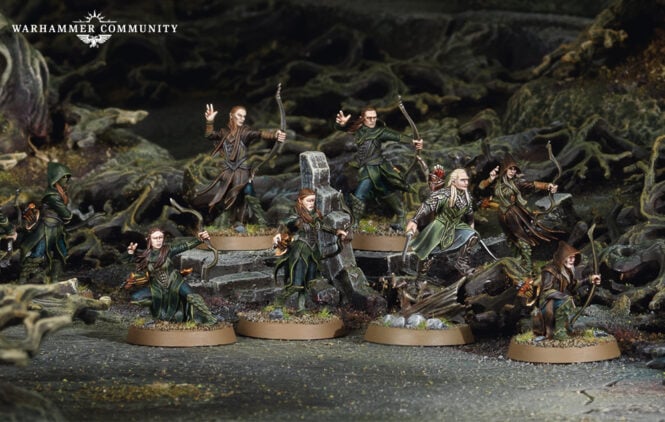
Photo Credit: Warhammer Community 

It should come as no surprise that Legolas is most dangerous when he's shooting. Shooting has been critiqued by various crowds in MESBG as contributing to a negative play experience, mostly because your opponent has no say about it once he's done moving his models. There's no opposed dueling roll, there's no resist test, and there's no armor save (for most units - some units grant saves of various kinds and heroes might have Fate points) - once you're done moving models, the other guy gets to shoot at you . . . and you have to take it. Legolas does this better than any other model, since his Deadly Shot special rule allows him to either perform three shots hitting on his normal Shoot Value (3+ if he hasn't moved, 4+ if he's moved up to half his max movement) OR perform a single shot that hits on a 2+ and ignores all modifiers (to include the move-and-shoot penalty, negative modifiers like Blinding Light, in-the-way rolls, and even the rule that prevents a Good model from shooting into a friendly combat). Yes, Legolas can do the shooting thing all the time.

While getting 3 shots each turn would appear to be his most deadly quality (and I've killed 2-3 models in a single turn plenty of times with him), it's the second part of his Deadly Shot rule that gives most competitive players pause. Usually, if you have an important support piece that you don't want to lose (a Goblin Scribe, a Dead Marsh Spectre, or a low-Defense/low-Wound army leader), you just tuck them behind 3-4 guys or a wall/rock and you're feeling pretty good about them not getting hit from enemy archers. But if Legolas can see the model, he can hit the model on a 2+ - even if he's moved that turn! Furthermore, if Legolas wants to hit the MOUNT of a big hero, he can choose which part of the model to target with the 2+ To Hit and if he's willing to spend Might to make it work, there are very few mounts in the game that can survive for long when Legolas is on the other side of the board. This is particularly true for any of the multitude of heroes who lacks Horse Lord and has no way to prevent wounds on their mounts. Oh, and Blinding Light won't make that mount any more safe . . . it's annoying.

Saturday, November 11, 2023

Fantasy Fellowships: The Erebor Reunion, Part 6c

Good morning gamers,

There are some scenarios that feel like they're horribly weighted towards one side (Good or Evil). There are some scenarios that look downright impossible to win for one side. There are some scenarios where you look at the scenario rules and just say, "Yeah, I just gotta kill everything and I'll finish the scenario objectives later." We've seen a bunch of these scenarios in Fantasy Fellowships . . . and this is going to be another one. :) The technical win conditions for the Docks of Harlond scenario is to get your Aragorn character and either your Legolas or Gimli character off the Evil player's board edge . . . but we can do this really easily by just killing everyone. And so, this scenario is yet another example of the best scenarios in Fantasy Fellowships: line up the enemy and smash them! Let's get into our last Pelennor scenario - and get back to the beater heroes in my Fellowship!

The Docks of Harlond

The plan here is simple: because we don't have Heroic March in our Fellowship, we're just here to kill lots of guys. The Orcs don't respawn in this scenario, so it's 40 of them against 30 of us - and we have FAR better heroes (and way more points) than they do! So yeah, we're just gonna kill things - and if they're running away from the back board edge and don't want to engage, we'll have Nori and Dwalin (because he's a diva and I can't trust him) run for the gate . . . because why not . . .

I don't have 20 Warriors of the Dead (with no extra gear!) or 6 Riders of the Dead, so I used my 10 Warriors of the Dead, 10 Nazgul of Dol Guldur/Castellan proxies, and my 6 Ponies of Equestria. To make this post a bit more interesting, I'll make some random comments about how well the ponies do.

Turn 1-3: Priority Good, Good, Good 

Good automatically starts with priority in most scenario missions and I won the priority roll on rounds two and three, so I advanced with my guys while Centaur held on the center for a turn and then retreated towards the more restricted deployment of the Rammos Echor gate . . . here are some pics:

The army of the Dunharrow advances towards the enemy, with the ponies driving up the right flank

We continue to press forward as the Orcs begin to fall back - the ponies stayed outside of 12" (so they couldn't be charged) . . .

The infantry continue to advance as the Morannons back up towards the gate - the ponies once again stay outside of 12" to avoid being charged on Turn 4 . . .

Thursday, November 9, 2023

Fantasy Fellowship Deep-Dive: Optimizing Your Characters, Part 3

Good morning gamers,

This is our third part in this mini-series on which characters are the "best" choices for Fantasy Fellowships - at least with the analytic model I've made. We've already looked at the Ringbearer and Companion slots, as well as the Rohan/Gondor "friend" slots, and today we turn to the Wizard and "Doomed hero" slots (or "who's going to replace Gandalf and Boromir"). Let's take a look!

The Wizard - Scoring Criteria

As we covered in a previous post, this character has fewer missions than almost any other member of the Fellowship (only Boromir has less screen time - and we're getting to his slot later in this post). Besides the Ringbearer slot, this is also the most constrained slot in your Fantasy Fellowships, since you have to pick a hero from one of the following ten characters:
  • Gandalf the Grey (not Gandalf the White)
  • Saruman the White
  • Radagast the Brown
  • Galadriel (not Lady of Light)
  • Elrond, Master of Rivendell
  • Celeborn
  • Cirdan
  • Arwen Undomiel
  • Gildor Inglorion
  • Thranduil, King of the Woodland Realm (presumably with the Circlet of Kings so he actually has some magical powers, but this isn't ACTUALLY required)
The list is basically the three wizards, two Elves who act like wizards (possibly three, depending on who else is in your Fellowship) and five (or four) other Elves who happen to have magical powers (or can get magical powers with a piece of war gear, in Thranduil's case). Given that they will only be participating in the four scenarios of the Moria Sequence (with a very critical role in the Bridge of Khazad-Dum scenario), one scenario in Rohan (Eomer's Return), two scenarios in Minas Tirith, and the End of All Things scenario to close out Fantasy Fellowships, here are the five categories that are important to them.

Dueling Profile

It's no secret - most magic casters in MESBG aren't great in combat. Usually, you want a few ranks of warriors standing in front of these guys to make sure they don't get torn apart by something big and nasty or a horde of really puny grunts - but that isn't an option in Fantasy Fellowships. Your wizard character might have 20+ guys to keep him safe as you ride to save Helm's Deep or defend the walls of Minas Tirith, but during the early missions, you're going to have a few brave souls to keep the pain off this guy - and with at least a few of those characters being Hobbits, even some of THOSE guys can't be relied upon to keep your wizard alive. As such, I've made this metric simple (perhaps overly simple - see the discussion below on this) and given a utility score to each character based on the number of attacks the hero has (in a few cases, this can be modified by their war gear):
  • Utility score of 1: 3+ Attacks
  • Utility score of 0.5: 2 Attacks
  • Utility score of 0.1: 1 Attack
  • Utility score of 0: Unarmed

Monday, November 6, 2023

Nemesis: How To Fight Against Ringwraiths

Good morning gamers,

So far in this series, we've looked at specific monster models (that usually show up in a single list, maybe two) or specific Legendary Legions that everyone seems to hate fighting. Today, we're turning to a model type that's pretty ubiquitous across the forces of Evil and units that don't look all that dangerous until they're neutralizing your heroes and chewing them up. Yep, it's time to turn to the Witch-King of Angmar and all his Ringwraith friends! I love these models (and have written quite a bit about them), so let's go in-depth today (fair warning, this post is LONG) and look at all the grisly bits about Ringwraiths, shall we?

What Makes Ringwraiths So Hated

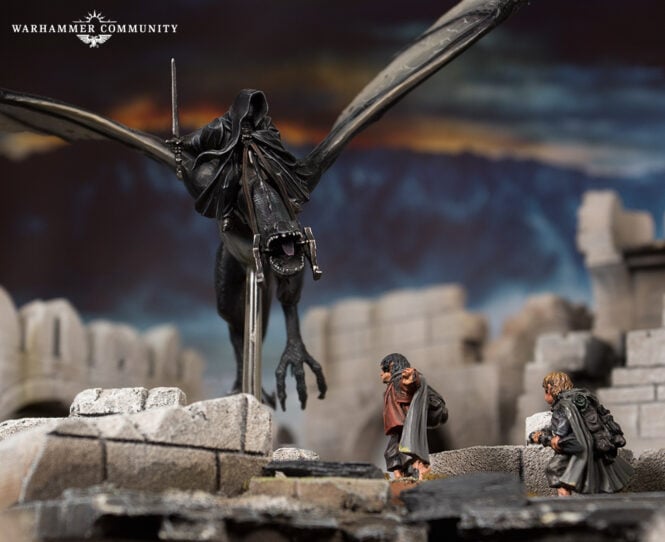
Photo Credit: Warhammer Community

Part 1: An Overly Pedantic Study of Ringwraiths

You can't start talking about Ringwraiths without going over a brief taxonomy of the ten Ringwraith profiles that we have and how they're usually fielded. Despite there being nine Ringwraiths in total, the generic "Ringwraith" profile (which you can actually take nine of - you don't have to run the Witch-King!) provides a nice "blank slate" version of a Ringwraith for you to customize to your liking. These guys have decent-not-good combat stats (F5/S4/1A with 0-2 Might) and decent-not-good defense stats (D8/1 Wound/0-2 Fate). As far as Heroes of Fortitude for Evil go, they are great for keeping your army in the field should you break with Courage 6 and with 7-14 Will points, they have the potential to cast magic and/or fight for a long time (but don't think this means they have a lot of Will - read my post on Multi-Purpose Will Casters for more information on this). Though they look fragile, the Terror-Harbinger-of-Evil combo (something we've talked about before) can make charging them particularly difficult.

Besides the Might/Will/Fate on these guys, you can also take mounts for your Ringwraiths in the form of horses (10 points - a good cheap option for increased speed, slightly increased damage when you charge, and an easier time getting the casting direction/look-angle you want on a target), Fell Beasts (50 points - slightly more speed with more maneuverability options, greatly increased damage when you charge, and opportunities to get casting directions/look-angles that are not present when you're on a horse), and Armored Fell Beasts (70 points, which just seems like too much to pay for +1 Defense on your Fell Beast . . .). While you "can" field these guys for 55 points each, I think it would be unwise to leave home without adding 2 Might points, at least 1 Fate point, and a horse (which brings these guys up to 80 points). Personally, I normally throw in 2 extra Will points (9 total) for a tidy 90 points, but 7 Will can be just fine (it just means you're casting for one fewer turns).

When you compare these basic Ringwraiths to the "named" Ringwraiths, there are some differences. First and foremost, each of the named Ringwraiths is a Hero of Valour (or Hero of Legend in the case of the Witch-King in the Mordor/Angmar army lists, as well as in the Black Riders Legendary Legion). While generic Ringwraiths have both Heroic March and Heroic Channelling for their specialized Heroic Actions, most of the named Ringwraiths just have Heroic Channelling. The Witch-King and Khamul are exceptions to this - both have Heroic Strike, and the Witch-King also has Heroic Resolve, Heroic Strength, and Heroic Challenge. For most players . . . yeah, you're probably sticking to Heroic Strike/March and the occasional Channel.

Thursday, November 2, 2023

Unexpected Military Formations: 3 Formations for Fighting Against War Beasts

Good morning gamers,

Today we've got a very special formations post for you - different formations you can use to fight against war beasts (and particularly Mumaks)! War beasts are a special kind of unit in MESBG (see my Back to Basics article from a few months ago for what makes these guys special) and it's often daunting to fight them, since you know they could walk all over your army (quite literally!) and wreck your day.

In preparation for our recent The Hunter's Red October (THRO) tournament, I very strongly considered borrowing a Mumak and running two of these things - and BOY was that fun (and scary for my poor testing buddy, Gorgoroth). But as scary as being stepped on is, there are actually some very simple formations you can employ to defeat them - and they're primarily based on the following principle: manage how many models can be stepped on. Let's take a look at a few of them.

Formation #1: The Scattered Triangles

I've referenced an article about running "skirmish triangles" a lot this year - and it's because I love shooting and I love not having my shooting be constricted by the way I deploy/maneuver my models. Any three shooting models that are standing base-to-base in a triangle have 360 degrees of visibility (since you can "look over the shoulder" of a friendly model that you're in base contact with) and so skirmish triangles are a great starting point for whatever archers you want to run to harass a Mumak.


Having three models standing together and moving around the Mumak does a few things for you. First and foremost, they present enough of a threat that the Mumak has to deal with them (either with the guys in the howdah or by moving the Mumak itself). Having a lone warrior here or there isn't going to pose much of a threat, but having two or three triangles (6-9 shots) coming from a single direction can force a Mumak to actually do something (and this is especially true if the war beast is a Great Beast of Gorgoroth, since it has fewer wounds and its shorter height could mean that elevated archers don't have the howdah in-the-way for the Orc archers on its back - I was wrong, the howdah is always counted as in-the-way).