Featured Post

The Road to the TMAT GT 2026: Tiberius's List

Good morning gamers, I love the week leading up to an event - lists are in (usually), spreadsheets are being made, rules are being reviewed,...

Friday, July 6, 2012

Game 1 - Lords of Battle: The Fellowship vs. Isengard

So with the Wood Elves getting their fair share of games, I thought it would be good to change things up and do something new. I recently finished re-reading the Fellowship of the Ring and came away thinking, "You know, I really miss playing games with the Fellowship." So this month, I'm shooting for playing 5 games with the Fellowship against 5 different opponents, and going through 5 of the new scenarios from the army books (we're not playing Reconnoiter, despite that being the closest to what the Fellowship was actually doing in the movies). The first game we have on the docket is a match with my good buddy Gaius, who played the first game on this blog with me. I'll be controlling the Fellowship during all five of these missions (or so is the plan), and here are the forces for today:

The Oathsworn: 500 points


Gandalf the Grey - 170 points
Legolas with armor and Elven cloak - 105 points
Gimli, Son of Gloin - 90 points
Frodo Baggins with mithril mail - 85 points
Samwise Gamgee - 30 points
Meriadoc Brandybuck - 10 points
Peregrin Took - 10 points


7 units, 1 Elf bow + 1 thrown axe + 4 thrown stones, 7 heroes, 1 warband


**Fellowship Warband special rule: so long as Frodo is alive, all Courage tests for the army being broken are automatically passed by each member of the Fellowship warband.

The Fist of Isengard: 498 points


Vrasku - 60 points (Army Leader)
Uruk Captain with two-handed weapon and heavy armor - 60 points
Uruk Captain with shield - 55 points
18 Uruk Warriors with shields - 180 points
11 Uruk Warriors with pikes - 110 points
3 Uruk Warriors with crossbows - 33 points


35 units, 3 crossbows, 3 heroes, 3 warbands

The scenario we will be playing is a Lords of Battle game on a board that is 48" x 48". Each army rolls a dice for each of its warbands to determine whether their army deploys anywhere on their board edge or within 12" of the middle of the table (on the roll of a 1-3). Once one army is broken, a dice is rolled: on a 1-2, the game ends and the points are tallied. If a 3+ is scored, another round is played and at the end of that round, a dice is rolled again. This continues until a 1-2 is scored on the dice at the end of a round. The means of scoring in this game are as follows:
  • 1 point is scored for each successful wound caused against an enemy unit and for each Fate point expended by an enemy unit. If a unit dies without using its Fate points, the unexpended Fate points provide 1 point each.
  • 1 point if the enemy force is broken at the end of the game.
  • 3 points if the enemy force was broken and the friendly force was not at the end of the game.
  • Special rule: if an enemy hero is killed in a fight, a friendly hero in the same fight (player's choice) can regain a Might point previously spent in the battle.
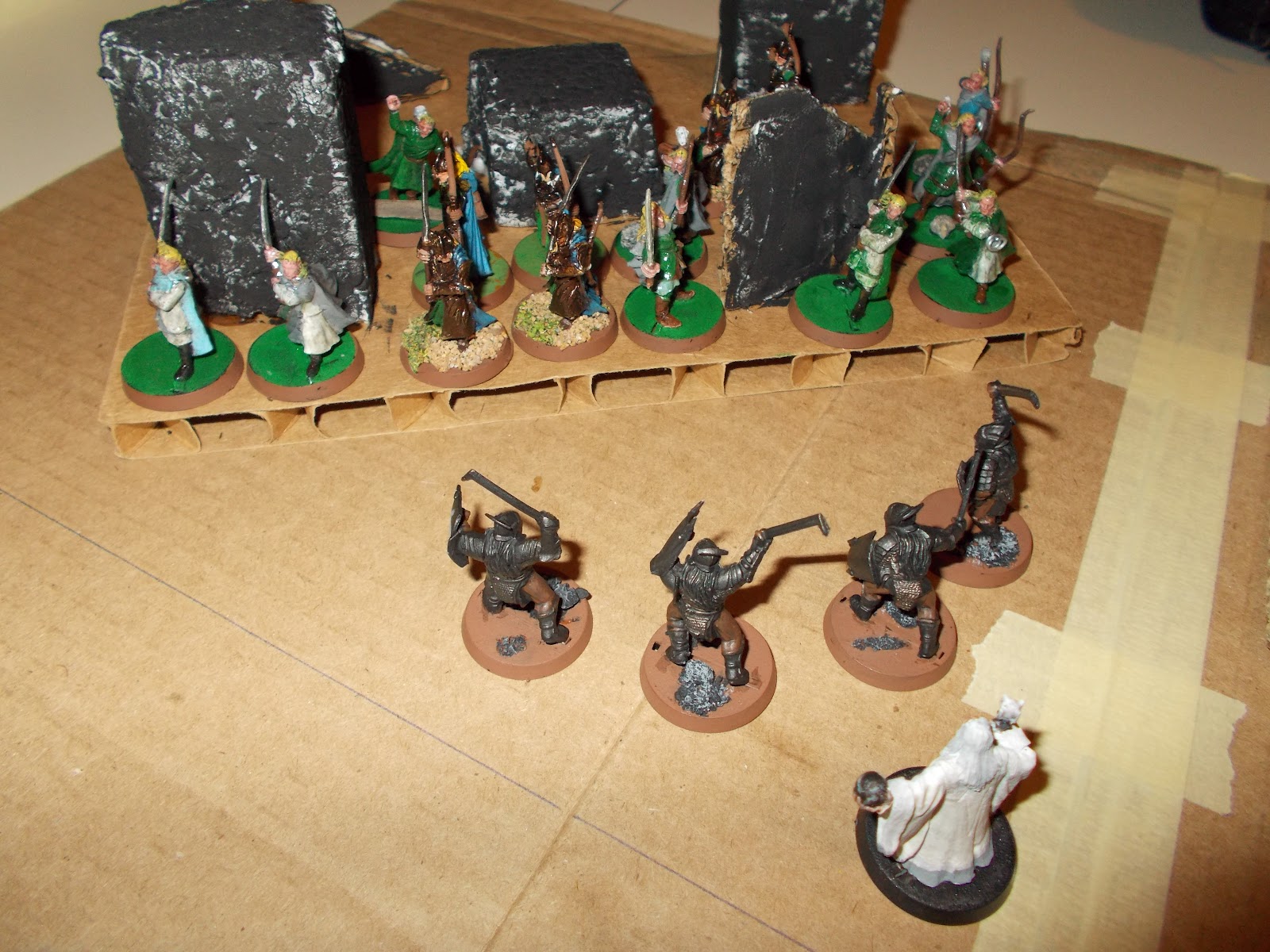
The map is set up as follows: a ruin lies in the center of the map and various rocks, hills, and assorted scenery surround it. The Uruk-Hai won the roll off and have chosen to select their board edge (the southern edge), ceding priority to the Fellowship for the first turn. One of the Uruk-Hai armies was forced to deploy within the front half of their board edge, while the others were allowed to be placed anywhere. They decided to remain close to the forcibly-advanced troop. 
The Fellowship was allowed to start anywhere and so began very, very close to the Uruk-Hai, with Gimli surrounded by Sam, Merry, and Pippin, while Legolas and Gandalf prepare to distract the larger contingent of the Uruk army and protect Frodo (who, as army leader, is safely behind a wall with the Ring in his pocket). 
So the Fellowship has been having a rough time in these scenarios, but this is a scenario which they are built to win. Not only is the goal to kill lots and lots and LOTS of people, but the enemy must engage your power heroes in order to have a chance to score enough points. My objective will be to keep the hobbits safely behind the forward lines to limit their exposure to crossbow bolts and forward attackers. At the same time, they need to be close enough that Gandalf and Legolas don't get engaged by more units than they can handle. I will need to rack up 18 kills before 4 are racked up on me to have a good shot at winning, so we'll see how this goes (and the Uruks have systematically defeated the Fellowship before, so this should be very interesting).


Turn 1: Battle Is Joined (Priority - Fellowship)
Gimli, Sam, and Pippin charge Uruk-Hai within the ruins, Gandalf casts Blinding Light (free W), Legolas prepare to fire into the Uruks, and Frodo moves near Gandalf and puts on Ring (very safe now and can pass through the ranks of the Uruk-Hai to surprise them). The Uruks move up towards Gandalf and Legolas, trying to hem in Gimli and the 3 smaller hobbits within the ruins.
Legolas kills an Uruk with pike (1/3 M) and Vrasku scores a wound on Gandalf, burning through 2 Fate points (2/3 F).  OUCH!!
WHITE LIGHT!!!! Sorry about that, but here's what happened. Gimli calls a heroic combat, pays a Might to win, pays his final Might to slay both (3/3 M) - uh-oh! Gimli wins his next round, but fails to wound anyone. Sam and Pippin lose, both take a wound - Pippin fails the Fate save and dies, and Sam passes his Fate save.
Score: Fellowship 3, Uruk-Hai 5.


Turn 2: Felled Like Trees (P - Uruks)
Gandalf unleashes Sorcerous Blast (free + 2/6 W), knocks 3 Uruk-Hai over, and kills none of them. Grrr... Gimli is surrounded within the ruins and Merry and Sam meet an Uruk-Hai Warrior at the gate. Things are not looking good, but I'll note that Frodo is happily walking behind the ranks and preparing for some nasty action... 

Legolas kills 2 Uruks with his arrows (3/3M), while the Uruks hold their fire to avoid collateral damage. 
Gimli is surrounded, loses his fight, and takes 2 wounds from 2h weapon captain (1/2 M). Thankfully, Gimli saves 1 with his Fate points (2/2 F, 1/2 Wounds), keeping him barely alive. Sam and Merry win their fight (Sam rolls a 6), and Sam kills the Uruk he is fighting (rolls another 6). "I think I'm getting the hang of this..." My thoughts: "Good, Sam, now save Gimli before he dies!"

Score: Fellowship +3 (6), Uruk-Hai +3 (8). Pictures get kinda scarce from here on out, as the game got really, REALLY intense...


Turn 3: A Wave Through The Ranks (P - Uruks)
Gandalf calls a heroic move, unleashes another Sorcerous Blast (free + 3/6W) and knocks 6 Uruks over including a Captain. The blast kills 3 of the Uruk-Hai (3/3 M). In response, the Uruks engage Merry and Sam separately, surround Gimli, and a skulking Uruk who ran around the far side of the ruins charges Gandalf.

In the Shoot phase, Legolas fails to wound anyone and an Uruk crossbowman scores 1 Wound on the Elf archer, but Legolas saves the wound while burning through 2 Fate points (2/3 F).

During the Fight phase, Gandalf is only one to score a wound during his fight. Gimli and Sam won their fights but failed to wound anyone and Merry lost his fight but wasn’t wounded.

Score: Fellowship +4 (10), Uruks +2 (10). 10 dead Uruks, 1 dead hobbit.


Turn 4: A Moment Of Great Loss (P - Uruks)


So things are a bit tight: all of the Fellowship except Frodo are charged this round, and Frodo tries to catch up to Gandalf and Legolas (1/2M to pass the Ring check). No shooting occurred during this round.

Gandalf is trapped, loses his fight, and takes 5 wounds from the Uruks (which is enough to kill him and score 4 point for the Uruk-Hai). Legolas scores a wound against one of the Uruk Captains, which is subsequently saved by Fate (1/1 F, 2/2 M). Gimli loses his fight, is trapped by his foes, and sustains 3 wounds. This kills him as well and scores 1 point for the Uruk-Hai.
Score: Fellowship +1 (11), Uruks +5 (15). The Fellowship is one unit away from breaking, but it's not looking good without Gimli and Gandalf...


Turn 5: Hope Fades (P - Uruks)
Everyone is charged by Uruk-Hai except Frodo. Frodo passes his Ring-test and moves towards a band of Uruks who have surrounded Legolas. He passes his Courage test to take the Ring off and charges one of them. No shooting occurred during this round.

The combats this round were terrible: Legolas lost a very one-sided fight against the Uruks who had stormed the Amon Hen structure and consequently suffered 3 wounds in combat (3/3F, 2/2H). Three more points for the Uruk-Hai. Frodo loses his fight and burns 2 Fate points to stay alive (2/3 F). Sam loses his fight, takes 8 wounds, passes his Fate save, but still REALLY dies (3 points scored). Merry loses and takes 2 wounds, unable to pass his Fate save (2 points scored). So, at the end of the round, it’s just Frodo and I cede the game (thankfully, he didn’t have the Ring on, or he would have been lost as a casualty).

Score: Fellowship +0 (11), Uruks +10 (25).

Post-game scores: Fellowship scores 0 more points for enemy being broken, Uruks score 3 for Fellowship being broken.

Final score: Fellowship 11, Uruks 28. Major victory for the Uruk-Hai (defined in the new scenarios as being double the enemy score).


Conclusion:

Assessment by Tiberius:

I love Uruk-Hai vs. the Fellowship games. I've come to the conclusion that as great as Uruk-Hai Warriors are with heavy armor and shields, their Scout counterparts with shields work about as well in melee combat against the Fellowship. The D6 is useful against the arrows of the enemy (and particularly the stones of the hobbits), but D5 opponents in close combat are just as good as D6 against an army of S4 heroes. At this point, I'm not interested in making that investment, but I may keep it in mind.

As I am going to be playing five more games with this army, I'm going to adjust my list a bit before the next game, which will be between me and Glenstorm. In that game, I'm looking at playing against another Uruk army, so I know I'm going to need some more killing power. So, it looks like Frodo won't be making an appearance. He is an interesting unit, and great for keeping the army together.

Assessment by Gaius:

The Uruk-Hai are best used as hero-killers or breaking through shield walls of D6 units. Since most of the Fellowship can't get higher than D6, this makes them superb foes for the Fellowship. I really liked taking the Uruk Captain with two-handed weapon, since he could use his two-handed axe against Sam, Merry, or Pippin and wound them on a 2+. AHHHH! Doing that to Sam was well-worth the whole game. :)

On a more serious note, Tiberius and I were wondering what would have happened if all of the Fellowship would have begun inside the ruins, instead of half of the Fellowship starting there. I'm not sure much would have changed, as the sheer number of Uruk-Hai would have still come down to bear on them, but we decided that Gimli probably would have been trapped much later and not had to waste as much early in the game. It is also possible that Legolas may have been able to gain a nice roost and shoot more.

Stellar unit for the Fellowship: Gandalf the Grey

Not a killer by normal rights, but Gandalf is a fun hero to use. Not only does he get the "Kaboom" spell for the army, but he also has the potential to make life a whole lot easier for your other heroes. In this game, we was protecting Legolas (cloaked) and since Uruks who are knocked down waste half of their movement to get back up off the ground, Legolas and Gandalf could back away 3" from their foes and maintain a good distance for another round. It didn't help that we lost priority during the important rounds, but this army can't help that. Though none of the Fellowship heroes killed very many units, Gandalf and Legolas killed 3 each, which made up most of the team's kills. A big shout-out goes to Sam, who defeated two Uruk-Hai and killed one of them.

Stellar unit for the Uruk-Hai: Uruk-Hai Warrior with shield

In close combat for games like this, it really doesn't matter if an Uruk-Hai has D5 or D6 (predominantly Strength 2 or Strength 4). Where this does matter is when Gandalf or Legolas is in the equation. Since Sorcerous Blast wounds the initial target with a Strength 5 hit and subsequent victims with Strength 3, having a D6 shield-wall not only means that the target is wounded on 5s (instead of 3s or 4s), but the units nearby are wounded on 6s. That's really good for keeping your army together and alive against a powerful wizard. Against Legolas' Strength 3 bow shots (or Gimli's Strength 3 axes), you get the benefit of only being wounded on 6s, which has kept many a vulnerable Uruk pikeman alive. It will be interesting to see how much more damage the Fellowship can do in their next game against Glenstorm's Uruk Scouts.

Thursday, July 5, 2012

Reconnoiter: Wood Elves vs. Goblins

So I was looking back over the first few games I recorded on this blog, and not only am I impressed with how far my armies have come, but I'm also tickled with the different strategies I played against Gaius and Glenstorm. My, how time flies. Today we're wrapping up Wood Elf month and this final game will be between Wood Elves and Goblins. Here are the forces in today's game:

The Defenders of Lothlorien: 502 points

Galadriel, Lady of Lothlorien - 130 points
Thranduil (proxy by Haldir) - 90 points
11 Wood Elf Warriors with Wood Elf spears - 88 points
9 Wood Elf Warriors with Elven blades and thrown daggers - 90 points
4 Mirkwood Guard with Elf bows - 44 points
6 Galadhrim Warriors with Elf bows - 60 points

32 units, 11 Elf bows + 9 thrown weapons, 2 heroes

The Denizens of Moria: 500 points

Durburz, Goblin King of Moria - 60 points
Goblin Shaman - 45 points
1 Cave Troll - 80 points
1 Bat Swarm - 35 points
12 Goblin Warriors with Orc bow - 60 points
16 Goblin Warriors with shield - 80 points
16 Goblin Warriors with spear - 80 points
Ringwraith with +1M - 60 points

49 units, 12 Orc bows, 3 heroes

The scenario we will be playing is the Reconnoiter scenario according to the new rules (but without the warband rules and some deployment changes). The game ends when one army is reduced to 25% of its starting force. At this point, the points are tallied as follows:
  • 1 point if the enemy force is broken, OR
  • 3 points if the enemy force is broken and the friendly force is not.
  • 1 point if the enemy army leader receives 1+ wounds, OR
  • 3 points if the enemy army leader is slain.
  • 1 point for each unit that crosses over the enemy player's board edge (the scouts who are performing the reconnoiter).
This game introduces the Wood Elf hero I'm thinking about adding to my collection (and who I will test today): Thranduil of Mirkwood. The great father of Legolas of Mirkwood costs 90 points (same as his son's base cost) but comes equipped with armor and an Elven cloak (which Legolas must purchase for +15 points). In exchange, Legolas has +1 Fate, -1 Shoot Value, and +2 shots in each Shoot phase (or automatically hitting with a single shot). Thranduil, for his part, has two key advantages over his son: first, Thranduil can upgrade your Wood Elf Warriors to "Mirkwood Guard", which gives them a 2+ Shoot value for +2 points. Second, he has the Circlet of Kings, which can automatically cast Aura of Dismay (see the post on Radagast the Brown for more info on this spell) once each game and it can cast Nature's Wrath once each game (see the post on combat spell-casters for more info on this other spell). Since Nature's Wrath can be opposed by an enemy spell-caster under the normal rules, we assume that Thranduil's "automatically cast" means that one dice was rolled and rolls a 6. Whether this can actually be resisted has yet to be resolved in an FAQ by Games Workshop. For the purposes of this game, we're going to assume that a 6 was rolled and the opposing force may then attempt to resist it if they wish to (those of us on the blog are currently trying to come up with a more fair way to resolve this, but nothing has been settled yet - what you are going to see in this blog is my first thought of making the spell resistible).
As an added challenge, I am finally taking my Wood Elves underground and they will be fighting in a battle against Goblins without the benefit of their precious woods. Thranduil provides some great benefits that might make up for not having woods, but we'll see how much of a benefit this provides. The Elves win the roll and choose their table edge, ceding priority to the Goblins.


Turn 1: The Guard Appear (Priority - Goblins)
Both armies move towards each other and prepare to meet at the walls of the deep. Galadriel fails to cast Blinding Light, which I'm seeing happen more and more on her first turn. The shaman, for his part, passes Fury and enrages the units around him as they prepare to charge the gates.
In the Shoot phase, the Goblins kill one Wood Elf swordsman with their volley of arrows.  
The Elves respond with keen shots from Thranduil, a Mirkwood Guard, and a Galadhrim Warrior, slaying 3 Goblins with shields. Both Thranduil and the Mirkwood Guard hit on 2s. :)
Kill count: Goblins 1/32, Elves 3/49.


Turn 2: A Foul Rage, A Strange Strength (P - Elves)
Galadriel finally gets the Blinding Light up, but last turn they were blessed in that the Goblins weren't in direct firing range. As you can see at the right of the frame, the Bat Swarm is slinking on the side away from the Elven bowmen.
In the Shoot phase, three Elven arrows find their marks on the main contingent of Goblins, but two of the Goblins (the two with shields on the ends of the battle line) shrug off the damage they've received and find new strength to continue the charge (1/1M). The third arrow, fired by a Galadhrim bowman, slays the Goblin he targets and he falls to the ground.
Kill count: Goblins 1/32, Elves 4/49.


Turn 3: The Headlong Assault (P - Goblins)
So now things are getting interesting. The Cave Troll charges head-long into the Elves and the Goblins prepare to close in (out of range last time means out of charging range this time). The Ringwraith attempts to cast Sap Will on Galadriel, but rolls a 1...bummer. (1/7W) Galadriel, in turn, successfully casts Immobilize on the Troll, but needs to pay a Might point to do so (1/3M).
In the Shoot phase, a Goblin archer hits an Elf swordsman in combat, passes the in-the-way roll, and succeeds in slaying him, breaking off an uneven combat and making things easier for his buddies.
Thranduil and a Galadhrim bowman, in their turn, slay two Goblin swordsmen as they attempt to scale the walls (1/3M), and on the other end, a Mirkwood Guard slew a Goblin spearman, shown below.
In close combat, not much happened (no picture to go with the words here, sorry). The Troll lost (of course) and took 1 wound from his assailants. The Goblins managed to kill one Elf swordsman, increasing the number of their kills yet again.  
Kill count: Goblins 3/32, Elves 7/49.


Turn 4: The Ground Shakes (P - Goblins)
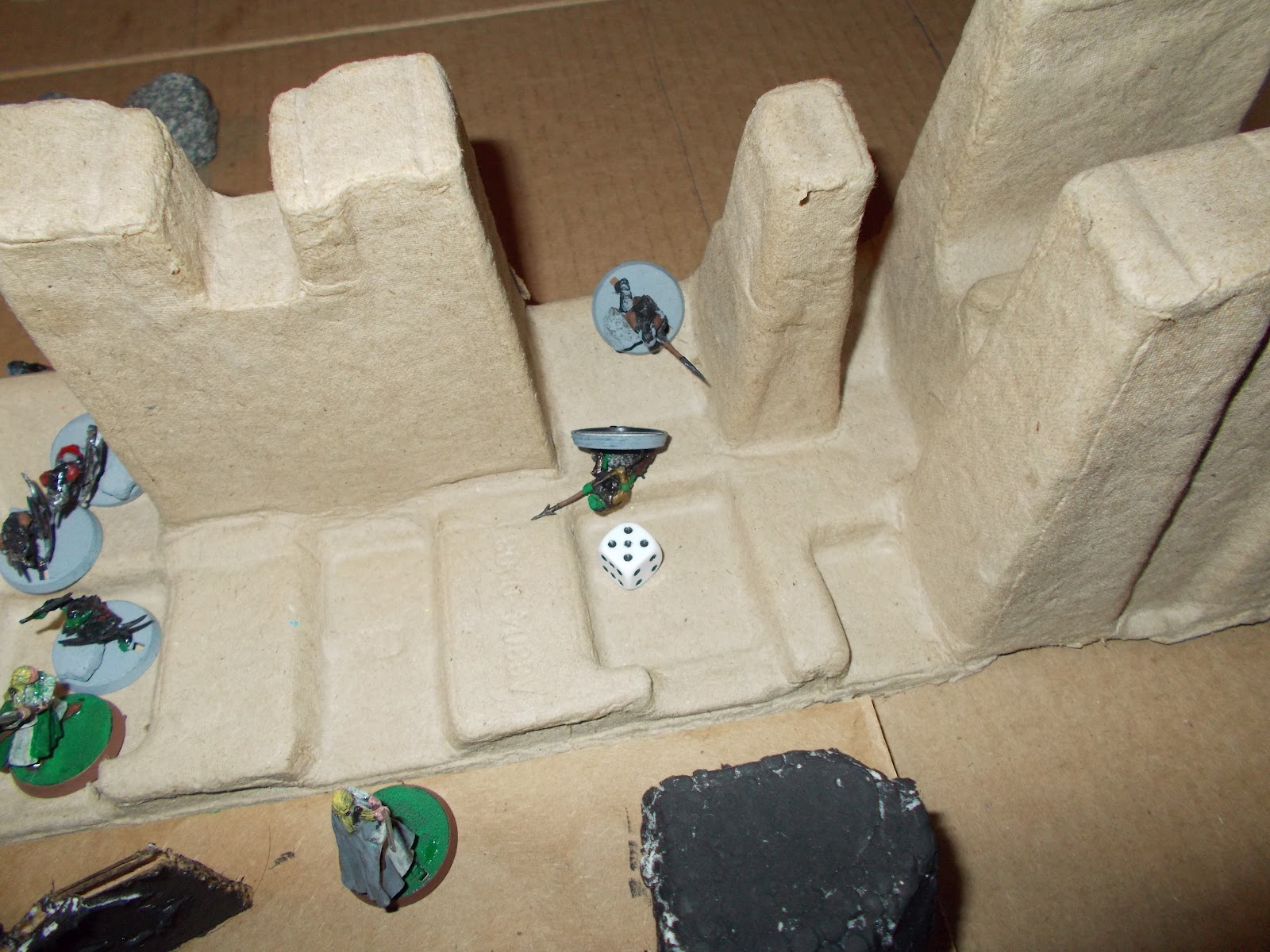
So, with the Goblins getting priority all the time, I'm tempted to call a Heroic Move with Thranduil to hinder the advance of the Goblins. Instead, I let the attacks play out, move Thranduil to a spot where Durburz (nor any other hero) will be in range, and let-loose Nature's Wrath, which sends the Troll and many Goblins (seen here) sprawling on their backs. Love that spell...
The rest of the moves panned out as you see here. The Ringwraith successfully cast Sap Will (2/7W), but his score of a 3+ was dispelled by Galadriel (2/3M). The drain he's putting on me is not fun, but with only 4 Will points at his disposal, I'm not anticipating this damaging my troops for much longer. On the plus side for the Goblins, the Bat Swarm (who had been skulking away the whole game) managed to cross the board edge and score one for the Goblins. That's not good for me, as my troops are stuck on my side of the board.
Archery this round was fairly even (and by "even," I mean terribly one-sided). The Goblins killed a Galadhrim bowman on the ramparts while another Galadhrim bowman killed one of the Goblin spearman who was out of range of the Nature's Wrath spell. He's the one on the ground next to the dice.
In the Fight phase, the Elves had most of the dominance: the Troll won, but stood up instead of wounding people (that was a pity). Thranduil wins his fight (2/3M) and slays both of the foes he pinned to the ground with his spell. Another Elven swordsman kills a Goblin with shield, further raising the kill count of the Elves.
On the right side, no one decided to die.
Kill count: Goblins 4/32, Elves 11/49. The Elves are 12 units away from breaking, while the Goblins are 14 units away from breaking - looking pretty good for the Elves right now, I must say...but...

In a move that I was loathed to make, we decided to call it a game here. The Goblins had scored and my newborn son was keeping me away from the game. By the end of Turn 4, it was midnight and I wasn't very hopeful on my infantry Wood Elves breaking through the ranks of the enemy, getting past their archers, and scoring 2 points before the game ended. I could break the enemy and be unbroken myself, which would score me 3 points (could be enough to win the game), but it was becoming quite likely that a few of the Goblins on my left flank would outpace my archers once safely behind the wall. So, since my Elves already have a powerful lead on my other armies, we tallied the score as 1-0 Goblins. Minor victory for the green skins.


Conclusion:

Assessment by Gaius:

So this wasn't really a victory (or at least, it didn't feel like it). But still, the mission was fun. I knew from the get-go that the Elves would be able to pose a solid line, but without Galadhrim Knights, their ability to move across the board is limited. This hasn't stopped them from winning Reconnoiter missions before, but I knew that the Bat Swarm would be my best scoring unit (the only unit on the board with speed). I really enjoyed this one and look forward to Tiberius' next monthly theme, which he told me about last night.

Assessment by Tiberius:

This game was far from over, but both I and Gaius were ready for bed. I've seen on another blog where a tight game is called off because of time constraints and it's always a pity to leave something so close, but we do what we must. As for the Elves, I'm very excited about Thranduil, though I'm still very partial to Legolas. I do like that the Mirkwood Guard can hit on a 2+, as it gave me 5 extra hits during the 4 rounds of archery that we had and 3 of those converted into wounds (one saved by Fury). This may not seem like a lot, but there's something very demoralizing for an opponent when your Elven bowmen refuse to miss their targets (some invariably do, but not many). Thranduil's Nature's Wrath spell could have also given a big break to my troops on the following turn, as a few units were still on the ground and priority is more likely to go to my team than the Goblins. Charging units on the ground is ever so much fun and I quite enjoyed seeing the Goblins fall (especially the Troll). If I was thinking, I would have spent some Will points with Galadriel during that last round and immobilized the Troll again, but alas, I did not. Next time, Gaius, next time...

Stellar unit for the Elves: Galadhrim Warriors with Elf bows

The armor of the Galadhrim doesn't help them stay alive longer against most bows (actually, all bows except Dwarf bows and Elf bows), but it makes them look a lot cooler and much more resilient in close combat than their cloth-covered cousins. In today's game, the Galadhrim killed 4 Goblin Warriors, tying Thranduil for kills. Though this was a low-scoring game (only 11 dead Goblins), these warriors were just ramping up their game, looking for more kills as the game continued. I'm glad I have them in my ranks and wonder what other Galadhrim Elves would provide...hmmm...

Stellar unit for the Goblins: Goblin Warrior with Orc bows

So, the archers rarely get the prize, but seeing as most of the FOUR kills they inflicted were inflicted by archers (three to be exact), and each of those kills required overcoming a penalty of sorts (volley fire, in-combat risk, and a building in the way), I felt compelled to give them the title today. The points gained from killing those units paid for half of the volley team and it is likely that a few more points could have been added to the score of these archers - especially if the Elves made a break for it. All told, I try not to leave without a 12-man volley team when I play as the Goblins because you never know how well they're going to do.

Friday, June 29, 2012

Spell-caster Evaluation: Saruman the Colorful

On the same day that Radagast the Brown arrived, he was joined by a powerful Evil wizard from Utah (or at least, he was mailed to me from there): Saruman the Colorful. Unlike the Good version of Saruman, this wicked wizard is a tad bit more expensive and more tactical.
Saruman the Colorful: Quick Review of Rules
Saruman has the wizard's standard Fight 5, Strength 4, Defense 5, Attacks 1, Wounds 3, Courage 7, 3 Might, 6 Will, and 3 Fate. Saruman receives a free Will point each turn and a two-handed weapon with his staff of power. Defense 5 is a tolerable defense against Strength 2 bows, but you can count on any enemy bows that can hit this wizard will choose to land there instead of your Uruk-Hai (who are wounded on the same to wound roll value).
Saruman has two important special rules: Voice of Curunir and The Palantir of Orthanc. The Voice of Curunir special rule gives Saruman a 12" Stand Fast! radius, perfect for ensuring that your Uruk-Hai stay to the bitter end. If you can keep Saruman alive until the bitter end, the value of the units that are not lost (especially when your Captains run away as frequently as mine do) when your army is broken. The Palantir of Orthanc special rule allows Saruman to automatically win priority for the Evil army before any dice are rolled. This is perfect for ensuring that you charge pesky Elves (or force them to use their Might to call heroic actions), counter-charge enemy cavalry, and tie down enemy killer-heroes with a single unit.
Saruman has four spells in his playbook, most of which he can cast very easily. Like other wizards, he can cast Terrifying Aura (causes "terror" if he has at least 1 Will left in his store) on a 2+ and Transfix on a 2+. He is one of a few wizards to be able to cast Compel on a 3+, which means that moving enemy heroes out of combats and away from your men is not hard (or making them fight worse fights than before in a weaker fighting strength).
Finally, Saruman can cast Sorcerous Blast on a 5+. This spell knocks units over and deals hits to them (Strength 5 to the target and Strength 3 to those who were hit by the flying body). This is a precision spell and great for two reasons: first, Uruk-Hai are great killers and if the unit is lying on the ground when attacked, the chances that the target dies are pretty good (without pike or spear support). Second, this is great for sending a hero with little to no Will points far from the battlelines, send him sprawling on his back, and forcing him to spend half of his next turn's movement standing up and getting his bearings. In those two turns, your units should be crashing through his lines and capitalizing on his loss.
Saruman the Colorful: Strengths in Use

Saruman the Colorful is a tactical hero who provides a benefit to your units in almost every phase of the game. To illustrate this, we'll look at each phase and see what benefits Saruman gives and assume he is working with the following army (600 points):
Saruman the Colorful - 170 points
*Vrasku - 60 points
Uruk-Hai Captain with shield - 55 points
18 Uruk-Hai Warriors with shields - 180 points
10 Uruk-Hai Warriors with pikes - 100 points
3 Uruk-Hai Warriors with crossbows - 33 points

598 points, 34 units, 4 crossbows*, 3 heroes

Once again, this army follows the rules for warbands identified in the new army books, though I would gladly trade the Uruk Captain for a few more warriors just to raise the numbers of the army. Still, this army provides a high Defense force to protect the White Wizard while he casts his magic.

Move Phase: Your Move

Saruman's key benefit to units during the Move phase occurs once during the game: when he chooses to use his palantir. Choosing when to use this special item takes some tact and should be made based on the threat that the enemy provides. Against a skirmish army (throwing weapons or bowmen who are preparing to move with ease through difficult terrain), using the palantir before a charge is a key goal. This should only be done if you can reach the enemy and preferably if there are no heroes in that formation. If there are, call a Heroic Move with Saruman to challenge your foe.
Against a non-skirmish army battle line, using the palantir before the great charge is less important unless there are cavalry in it. If there are no cavalry units or skirmishers, use the palantir after the battle is waging, ensuring that you get to charge vulnerable units (and tie down heroes). This maximizes the use of your Uruk's Strength 4 and superior fighting skills.
Move Phase: Casting Magic
Saruman's magic is very offensive. During your first turn, you should use your free Will point to cast Terrifying Aura on Saruman to ensure that weak-willed units have a difficult time ganging up on the wizard. with this in mind, your focus should be on utilizing offensive magic against the heroes and warriors of your enemy.
Using Transfix is simple enough: roll one dice, don't get a 1 on it, and watch your foe try to resist it (if he can) or risk being clobbered by your Uruks in the front ranks. Your opponent only needs to face the strength of the Uruks in a single fight with a hero he likes and he will be sure to avoid receiving a beating from them again. The best targets for making this a quick mission is to target captains of the enemy (0-1 Will). With a single Will point (or none at all in the case of a Dwarf Shield-bearer), they can only stop your magical onslaught once at maximum (barring a nearby wizard casting Strengthen Will on them). In the turn that the magical spell is not resisted, let your Uruks (2+ dice) rend the hero and break him hard - and I mean HARD!
Compel is cast on a 3+ and this is a remarkable feat for a wizard. For one point more than Transfix (probably still cast on a single dice), you gain all of the neutralizing benefits of Transfix but add the ability to make a unit move half of its movement even if it has moved already. You can't make him charge someone and you can't make him walk off a cliff, but your target is yours to move as you wish. This can be used to draw a hero out of a front line to be consequently charged by your units OR move a banner-bearer beyond the range of his companions, making him useless. This spell has lots of potential and is great for keeping heroes out of the action or even forcing them backwards away from the fight and prevent them from rending your ranks or scoring many points.
Sorcerous Blast is the most dangerous spell that Saruman has and will make him a definite target by any wise foe. Sorcerous Blast is cast on a 5+ and should use 2-3 dice, depending on how desperately you need it to work. I recommend only using 2 in most cases, unless the guy you're blasting away has Will points. Generally speaking, you want to avoid targeting someone with Will points unless you're trying to send the hero far away from the front lines (see the discussion above). If you want to get the biggest benefit from the spell for your Uruk-Hai, you should shoot a target who is at the end of a battle line and make sure that you blast him directly away from you down his battle line. Anyone who is not killed by the blast will be on the ground, waiting for your Uruk-Hai to beat him up while he's down. This maximizes the potential of the Uruks and provides a broader application of the Transfix principle identified above.
Fight Phase: Heavy Support
Saruman's profile is good enough to make him a competent fighter, but not great enough to make him a great warrior. With a single attack, he won't do too much killing, but his two-handed weapon rule from his staff and Fight 5 means that he provides some valuable support to an Uruk-Hai attack line. I would not recommend, however, that he fight on his own unless he's charging someone he transfixed, since Saruman won't be able to be wounded, regardless of who wins the fight. Besides that, not much gained from Saruman in the Fight phase that wasn't gained in the Magic phase.
Saruman the Colorful: Weaknesses in Use

Saruman is a powerful and capable wizard and provides offensive strength that few wizards can contend with (and other combat heroes should rightly fear). He, like all wizards, is far from invisible and we shall now view some of the concerns for protecting this wizard.

Move Phase: Charge!
Charging Saruman while he has Terrifying Aura is difficult for most units. Since many Good units have good courage values (failing courage tests 17-28% of the time) or the Bodyguard special rule, charging units that cause terror with these sorts of units is not hard. Once engaged in combat, Saruman can't cast spells (and if this happens before he is able to get his spells off, you've bought your heroes a great opportunity to go smashing through Uruk-Hai or leveling the wizard in close combat).
But besides charging Saruman, a clever spell-caster can drain Saruman's magic capabilities by casting spells that threaten his spell-casting capabilities. If Saruman is charged by a unit or two and is subsequently targeted by an Immobilize spell, the commander of Evil would be well-advised to attempt resisting the spell unless he can get those units off of Saruman. With only 6 Will points in his store, this entitles Saruman to a few turns of resisting magical attacks (or attempting to resist them) while being able to cast his own magical attacks. By charging him first, the greatest asset of this wizard (casting magic) is lost. It would be a good idea to have a thick line of Uruk-Hai between Saruman and his foes, and be aware of heroes sweeping around the edge of your line with a Heroic Combat or on their battle steeds...these guys can spell real trouble for you.
Shoot Phase: Arrows!
One of the most straight-forward ways to deal with a wizard (especially since this one doesn't have the Blinding Light spell) is to shoot him. A Defense 5 wizard like Saruman is just as resilient as any other units in this army against Strength 2 bows, but remains dangerously vulnerable against Strength 3 bows. Being wounded on a 5+ by a S3 bow is a danger to the largest investment of your army (and if those bows come in volley teams, you had better have a plan for keeping Saruman alive). To ensure that volley fire doesn't kill your wizard, a small group of Uruk-Hai with shields should guard him and should receive all assigned hits for volley fire to ensure that the wizard doesn't die. When the enemy is shooting directly at Saruman, your best bet is to just avoid archer lines entirely.
Fight Phase: Go-Go-Go!
As was discussed earlier, Saruman is vulnerable in a fight. With a single Attack and a handful of supporting Uruk-Hai, Saruman can be overwhelmed by sheer numbers or by a lone hero who is capable of evading the magical spells of his foe. In order to avoid this, it would be a good idea to have a good bodyguard of Uruk-Hai to even the odds and keep the number of warriors fighting Saruman low (sound like familiar advice...like you've heard it earlier in this post?). Against one or two foes, Saruman can do alright...get more than 3 attacking dice against him, and Saruman's in a tight pinch.
These are a few thoughts on Saruman the Colorful, who I have really enjoyed using (though he has yet to win me a game). On the whole, Saruman should be fielded in a 600 point army to allow him to field a few Uruk Captains for additional killing power, since it's hard for him to carry the team with Sorcerous Blast only.

Thursday, June 28, 2012

Understanding the Game: Sample Armies With Spell-Caster Focus

In an earlier post, I made a few lengthly observations about spell-casters in this game. To demonstrate how you can utilize these different types of heroes, I've included two of my armies as a reference (and would love to see your lists and some commentary if you have them), following all of the rules for warbands:

Forces of Good: 499 points


Galadriel, Lady of Lothlorien - 130 points
Celeborn with Elven blade, shield, and heavy armor - 150 points
5 Wood Elf Warriors with Elven blades and throwing daggers - 50 points
11 Wood Elf Warriors with Wood Elf spears - 88 points
3 Galadhrim Warriors with Elf bows - 30 points
3 Galadhrim Warriors with Elf bows and Elven blades - 33 points
2 Wood Elf Warriors with Elf bows - 18 points


26 units, 8 Elf bows, 2 heroes

This army has two expensive heroes, but Wood Elves benefit from being relatively cheap (7-10 points each) and this gives us a cushion for adding units to the army. Unlike most armies that I try to field, this force does not sport a volley team, but the two heroes in the army provide you the ability to move quickly into engagement with the enemy (or at least get within direct fire range). Galadriel's Blinding Light will protect the unarmored Wood Elf Warriors from enemy archery at close range and her aggressive spells will ensure that powerful enemy units are not able to deal their full damage against your units. In addition to the 13 ranged weapons in this list, the army includes Celeborn - the least used Elf hero I own. With 3 Attacks at Fight 6 and 3 Wounds with Defense 7, you have a very capable combat hero who can also immobilize a key unit or two that he charges.

The Denizens of Moria: 500 points

Durburz, Goblin King of Moria - 60 points
Goblin shaman - 45 points
Goblin Captain with shield - 40 points (leaping-off-a-rock guy)
1 Cave Troll - 80 points
1 Bat Swarm - 35 points
12 Goblin Warriors with shields - 60 points
12 Goblin Warriors with spears - 60 points
10 Goblin Warriors with Orc bows - 50 points
Ally: Ringwraith with 1M/8W/1F - 70 points


40 units, 10 Orc bows, 4 heroes

This army benefits from having two very cheap heroes who provide limited spell-casting abilities. Neither the shaman nor the Ringwraith have a large store of Will points, but each provides a key benefit to the army. Since heroes that thrive on killing pose the greatest threat to this army, the single cheap Ringwraith is helpful for slowing down this hero (or allowing him to be flattened into a pancake by the Troll's hammer). The shaman ensures not only that the core of your Goblins stay together, but also attempts to keep the size of the army large while the fight progresses. You could replace the Bat Swarm in this army to make your Ringwraith stronger (or choose the Witch King for your force to deal with spell-casters with staffs of power), but the Bat Swarm in this army serves not only to make your units stronger, but also distracts the enemy from shooting at/using magic against more valuable units (like your Troll).

As I mentioned in the previous post on spell-casters, we're going to be setting up a game with the two armies listed above and specifically highlight how the spell-casters worked in the scenario, so be on the look-out for that.

Sunday, June 17, 2012

Understanding the Game: Using and Fighting Spell-Casters, Part 3

EDIT: If you found this page, you should know we've posted an update for the new MESBG rules (2018)! You can find the updated pages here (Combat Mages) and here (Auxiliary Mages).


This post will wrap up our discussion on using and fighting spell-casters - specifically, those units who have a spell or two up their sleeve, but fill other rolls in an army. We will begin with the combat mages who are excellent warriors and potent spell-casters.

Using Spell-Casters: Combat Mages (Elrond & Celeborn)
Combat mages are rare in the game and by-and-large are only wielded by the Elves. These heroes combine limited spell-casting abilities with a strong warrior profile and are typified by the heroes Elrond and Celeborn. Both of these heroes have the standard Elven combat skills of Fight 6, Attacks 3, Wounds 3, Strength 4, and Defense 7 (if Celeborn is given a shield and heavy armor). Each also has a small selection of valuable spells that they can cast.
Elrond has the devastating Nature's Wrath spell. Since only one unit within 6" of Elrond can resist the spell, this can be unleashed most effectively when near a region without a hero (no Will = no chance to resist a spell...tough bunnies for you). Since the spell knocks all of the nearby enemies to the ground, this can provide you with the opportunity to not only double your wounding dice against your enemies, but also eliminate their ability to wound you this round (which is great if your enemy is an Uruk army or another force that focuses on bringing brute strength against your men). If these units haven't moved, though, you'll face a few getting up and staggering towards your lines, so be wary.
While Elrond's aggressive spell is valuable for assisting a squad of warriors, Celeborn's aggressive spell is more precise. He has the ability to cast Immobilize on a 3+, which means that he will likely be using this spell against enemy heroes (or monsters or cavalry or another strategic unit) that he fights. He also has the ability to cast Aura of Command, which allows your units within 6" of him to pass any courage tests they are required to take, but this spell should not be cast if you are fighting with an army of Elves (you really shouldn't need it). Instead, save your Will points to immobilize targets. 
Fighting Spell-Casters: Combat Mages
Fighting combat mages with melee units can be difficult, as these wizards are specialists in melee combat. For the Elven heroes highlighted above in particular (though the Dark Lord Sauron also qualifies on this list), your basic troops will be at a huge disadvantage if they try to dog-pile on these heroes. This strategy can work, of course, like it does against other melee heroes, but this often takes time and can be very costly in a close game.
Shooting these heroes can be hard too, especially if they take as much armor as their entry allows them (Defense 7 for Celeborn, Defense 8 for Elrond). Even the best missiles are not likely to cause much damage against these heroes, so we need a better option.
Here again, I recommend using a wizard or spell-caster of sorts. Like other melee specialist heroes, these combat mages have their Will store capped at 3 Will. Unless Gandalf casts Strengthen Will on one of these heroes (and boy, that's an expensive chunk of your army spent on two units), those Will points are not going to grow. Cast two spells at a critical moment, and these heroes may not be able to even cast spells. Nazgul are particularly good in this case, because their inherently large Will store will discourage hte use of their aggressive spells while posing a threat against the army itself.
Using Spell-Casters: Auxiliary Mages (Shaman)
The final category of spell-casters are the "auxiliary" heroes. These characters cast a spell that benefit a group of nearby troops. The Cast Blinding Light and Aura of Command spells discussed above fall into this category. Another common spell though is the Fury spell cast by Shamans in evil armies. Since most evil armies (especially those with Orcs and Goblins) have low Courage values, the most important element to any army is the ability to keep soldiers in the field once the going gets tough. The Fury spell not only allows all units of the same race as the shaman pass any courage tests, but the spell also gives the same warriors a 6+ Fate save whenever they suffer a wound. This isn't going to (or supposed to) save a lot of your units, but it will save a few. This is, in the end, what really matters, since it keeps a larger army alive a bit longer.
Fighting Spell-Casters: Auxiliary Mages
Fighting these heroes is easy, if you can reach them. Since these units are generally not combat-heavy units (exception for Celeborn as mentioned above), melee units in large numbers can easily beat these heroes. For shamans in particular, since they are no more than enraged standard units, it is not very difficult to defeat them in combat with elite troops and sometimes with normal troops (Goblin Shamans have Fight 2 and Defense 4).
By the same token, these units could be shot at from a distance (Blinding Light excepted) relatively easily, but you will probably need to cut through two ranks of units before you can see the skulking support hero. Gaining a high vantage point is essential for killing the hero this way, or getting around the flank of the enemy. Occasionally, a combat hero will attempt to cut his way through your ranks. For this reason, it may help to have warriors with bows behind your lines to shoot the hero once the lines open up (if he has Defense 5-9, however, wounding him with bows may be difficult).
You can use a dedicated spell-caster to deal with these heroes if you want to, but the most effective way to utilize a spell-caster is to allow your other units to clobber the mage. How? Command/Compel. By drawing out a hero around a flank (or towards one of your flanking forces/combat heroes who is running through the ranks), you can defeat these heroes easily and send them into the ground. In the case of the Fury-casting shamans, a simple defeat will extinguish the spell.
These past few posts show some of the means to use and fight spell-casters, but my greatest hope is that more armies will welcome these elite units into their forces during games on the table top. I'm going to go over in a later post how you can mix these different types of heroes and then see if we can get a scenario going with these sample armies for a fun game.